
Key Takeaways
- AEC covers the full built-asset lifecycle — design, engineering, approvals, procurement, delivery and handover — not construction alone.
- A decision made in design can cascade into engineering, procurement, site sequencing and final handover data.
- For Australian firms, the core operational risk is losing control of the project record as authority shifts between teams.
The AEC industry is the architecture, engineering and construction system that moves a built asset from early need to operational use in Australia.
It sits behind hospitals, rail networks, residential towers, schools, warehouses and public infrastructure, but its commercial importance is not only the asset that gets delivered. AEC work matters because responsibility shifts as a project moves from design intent to engineering evidence, approvals, procurement, site delivery and handover.
For Australian firms with 7–100 staff, the risk of AEC industry is whether the project record stays controlled as decisions move between teams.
The Australian Bureau of Statistics reported A$20.43 billion in total building work approved in February 2026, which gives that workflow pressure a practical market context. Approved work still has to pass through coordination, pricing, construction release and asset handover before it becomes usable value.
Let’s break down how it all fits together in this article.
What is the AEC industry?
The AEC industry means the combined work required to plan, design, approve, build, hand over and operate built assets. In Australia, that work is carried by several disciplines and service roles across the project lifecycle.
Plus, AEC work across the sector includes:
- Architecture: Spatial planning, design intent, planning material, documentation and design coordination.
- Engineering: Civil, structural, mechanical, electrical, hydraulic, fire, façade, acoustic, geotechnical and sustainability inputs.
- Construction: Procurement, site delivery, programme control, safety, quality, defects and handover.
- Related services: Cost planning, project management, certification, planning, digital engineering, facilities management, and asset data.
The point is that AEC work is sequential but not cleanly separated, so:
- A design decision can change an engineering assumption.
- An engineering response can change procurement.
- A procurement decision can change site sequencing or handover data.
With that kind of flexibility, AEC is usually discussed as part of the built environment and asset lifecycle because:
- Built environment: AEC work shapes buildings, infrastructure and places people use.
- Asset lifecycle: AEC decisions affect how an asset is designed, approved, built, maintained, upgraded and operated.
The same AEC structure applies across schools, apartments, health upgrades, rail works, warehouses, water assets and mixed-use precincts, although the approval pathway, consultant mix and handover requirements change by asset type. Here are clear examples of Australian projects:
- A major infrastructure rollout, like a new metropolitan rail line.
- A high-density residential build-to-rent development.
- A 6 Star Green Star rated commercial office fit-out.
What is the Difference: AEC vs Construction-only?
AEC is broader than construction-only because it includes design, engineering, approvals, procurement, information management, construction, handover and operations.
Comparison table below can help you break down the difference between AEC and construction-only in several points:
| Point | AEC | Construction-only |
| Scope | Whole built-asset lifecycle, from early brief to operations | Physical site delivery and completion |
| Main work | Design, engineering validation, approvals, procurement, information release, delivery and handover | Site mobilisation, trade coordination, programme control, quality, safety and completion |
| Key information | Models, drawings, specifications, reports, approval evidence, procurement schedules and asset data | Construction drawings, RFIs, shop drawings, site instructions, variations, EOTs and defects |
| Control point | Whether design intent, engineering evidence, approval status and release authority stay aligned | Whether site teams are building from current, authorised and contractually clear information |
| Main risk | The approved record, priced scope and working record drift apart | Cost, delay, rework, subcontractor claims and quality issues appear during delivery |
| Commercial tension | Authority shifts between owner, consultant, certifier, builder and operator | Builder must deliver against contract documents, site conditions and formal instructions |
| Handover impact | Asset information must remain usable for operations, compliance and future upgrades | As-builts, O&M manuals, warranties, defects and commissioning records must close out cleanly |
In terminology, people often say “construction industry” when they mean the wider AEC system.
When government reports, or media discuss “the construction industry”—such as the Australian Bureau of Statistics tracking dwelling approvals and building activity—they usually refer broadly to the whole supply chain. Technically, however, construction is just the “C” as you can see in the illustration below.
For example, The architect designs the ward layouts for optimal patient flow, while the engineer calculates the complex structural loads and mechanical ventilation.
And the constructor coordinates the subcontractors to physically bring that documented vision to life. And as you might expect, the handover between those responsibilities is where delivery friction usually starts.
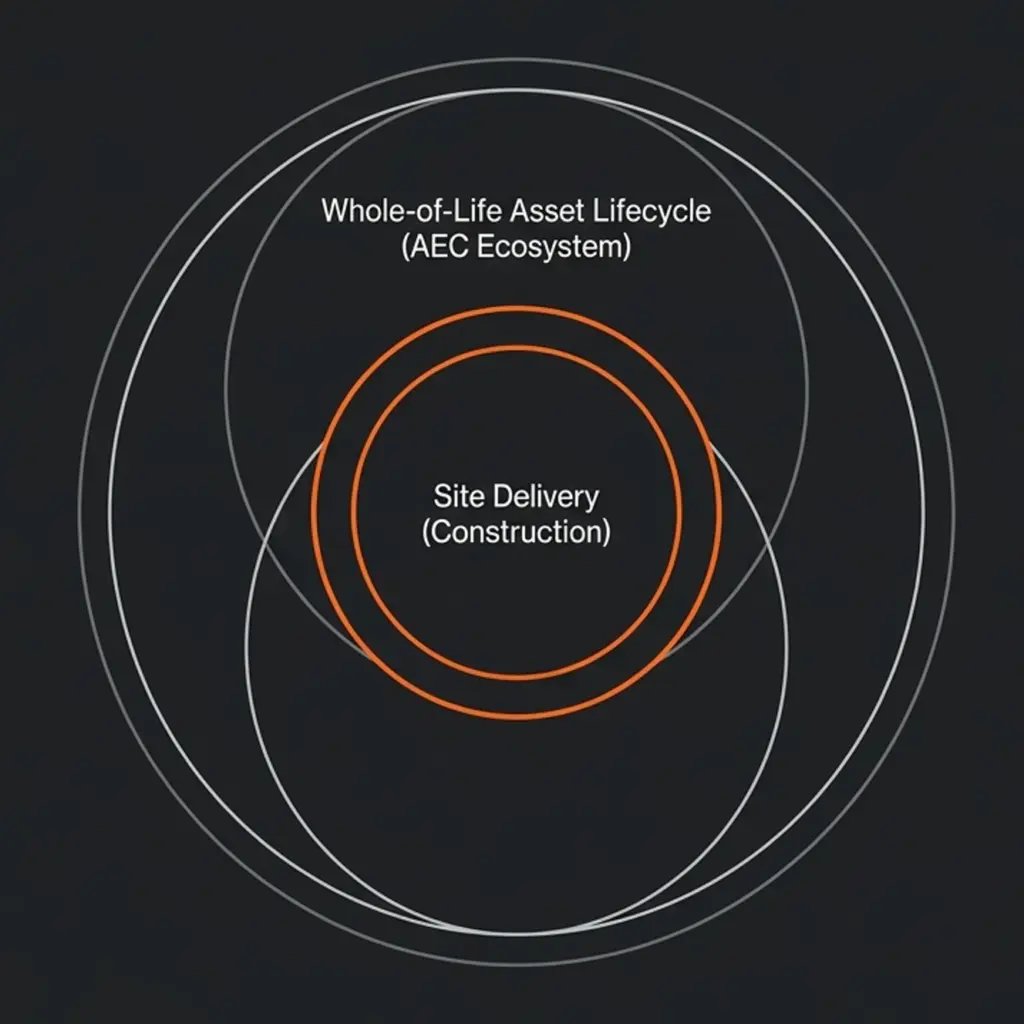
What Does Each Part do for Architecture vs Engineering vs Construction?
Architecture
Architecture sets the spatial, functional and documentation basis for the project. The core responsibilities of architecture is to translate the brief into layouts, design intent, planning material, setting the aesthetic vision, and leading planning approvals. Typical architecture outputs include:
- Concept drawings
- Planning drawings
- Room data
- Material and finish schedules
- Coordinated documentation
- Model views and drawing sets
Engineering
Engineering tests whether the design from architecture can perform safely, practically and in line with technical requirements.
Engineering converts design intent into calculations, system layouts, tolerances, reports, specifications and certificates. That’s why engineering disciplines usually came from:
- Civil (earthworks and drainage)
- Structural (framework and load capacities)
- Mechanical (HVAC)
- Electrical (power and lighting)
- Hydraulic (water and plumbing
Typical engineering outputs include:
- Structural calculations
- Civil and services drawings
- Fire and façade reports
- Mechanical, electrical and hydraulic schedules
- Technical specifications
- Coordination comments
- Construction-stage responses
Engineering responsibility becomes commercial when a technical assumption affects compliance, buildability or site sequencing.
Safe Work Australia states that a PCBU is the primary duty holder in construction work and must manage risks to keep people safe. That makes design assumptions, construction methods and coordination duties part of the same risk chain.
Construction
Construction turns approved design, procurement decisions and contract documents into physical delivery. The site delivery responsibilities of construction are:
- Managing site logistics
- Coordinating subcontractors
- Maintaining quality control
- Ensuring strict compliance with the Model WHS laws.
With those responbilities, typical construction outputs include:
- Construction programme
- Procurement schedules
- RFIs
- Shop drawings
- Site instructions
- Inspection records
- Variation claims
- Extension of time notices
- Defects lists
- As-built information
Who Works in the AEC Industry? Key Stakeholders in the Ecosystem
AEC projects involve several four main stakeholder groups,from client to Facilities manager, because no single party controls the full project record from early brief to operation.
Each group owns a different part of the decision chain, and the handover between those groups affects scope, approval, cost, delivery and asset use. Let’s break down the key stakeholders in the AEC ecosystem down here.
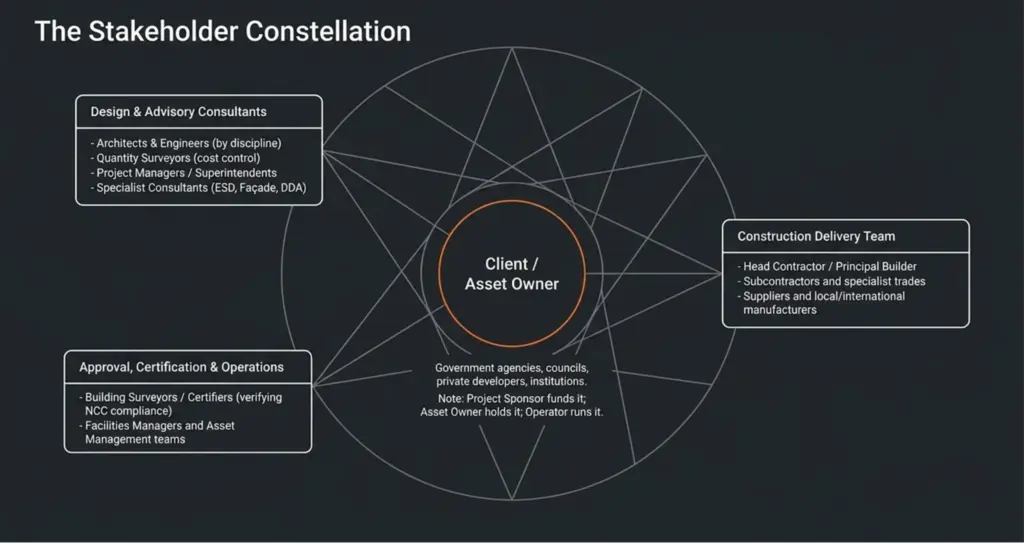
Client/Asset Owner Side
The client side defines why the asset is needed, what it must achieve and which constraints govern delivery.
In Australia, this side may include government agencies, councils, private developers, institutions and operating entities, as you can see in table comparison.
| Role | Function |
| Project sponsor | Funds or authorises the project |
| Asset owner | Carries long-term ownership risk |
| Operator | Needs the asset to work after handover |
| Government agency, council, developer or institution | Sets objectives, approvals, budget and governance expectations |
The risk appears when funding, user requirements and operating needs are treated as separate decisions. That separation can later show up as scope change, handover gaps or approval delay.
Design and Advisory Consultants
Design and advisory consultants shape scope, compliance, cost and delivery decisions before construction begins.
This group includes architects, engineers, cost consultants, project managers, superintendents, contract administrators, planners and technical specialists. Let’s see how each role work:
- Architect: Leads spatial planning, design intent, planning material, documentation and design coordination.
- Engineers by discipline: Provide civil, structural, mechanical, electrical, hydraulic, fire, façade, acoustic, geotechnical and sustainability inputs.
- Quantity surveyor/cost consultant: Prepares cost plans, tests scope against budget and supports cost control as design decisions change.
- Project manager/superintendent/contract administrator: Coordinates delivery governance, administers contract processes and manages formal directions, claims, RFIs, variations and timing issues where relevant to the appointment.
- Planners and specialist consultants: Support approval, compliance and technical risk areas such as planning, fire safety, acoustics, façades, ESD, sustainability and geotechnical conditions.
Construction Delivery Team
In Australia AEC, the construction delivery team converts approved scope into site work. This group controls programme, trade sequencing, procurement timing, site records and physical completion.
- Head contractor/builder: Holds the main construction contract, coordinates site delivery and manages programme, subcontractors, safety, quality, claims and completion obligations.
- Subcontractors and trades: Deliver specialist work packages such as structure, services, façade, interiors, hydraulics, electrical, fire systems and finishes.
- Suppliers/manufacturers: Provide materials, equipment, systems and prefabricated components that need to match specification, lead-time, certification and installation requirements.
Approval, Certification and Operations Roles
Approval, certification and operations roles test whether the project can move from design record to compliant asset use. Their work becomes important when design evidence, construction evidence and handover data need to remain traceable.
- Building surveyor/certifier: Reviews whether design and construction evidence meet the relevant approval pathway, including National Construction Code requirements where applicable.
- Facilities manager/asset management teams: Take over the asset after handover and rely on as-builts, O&M manuals, warranties, asset registers and maintenance information to operate the facility.
How AEC Projects Run in Australia
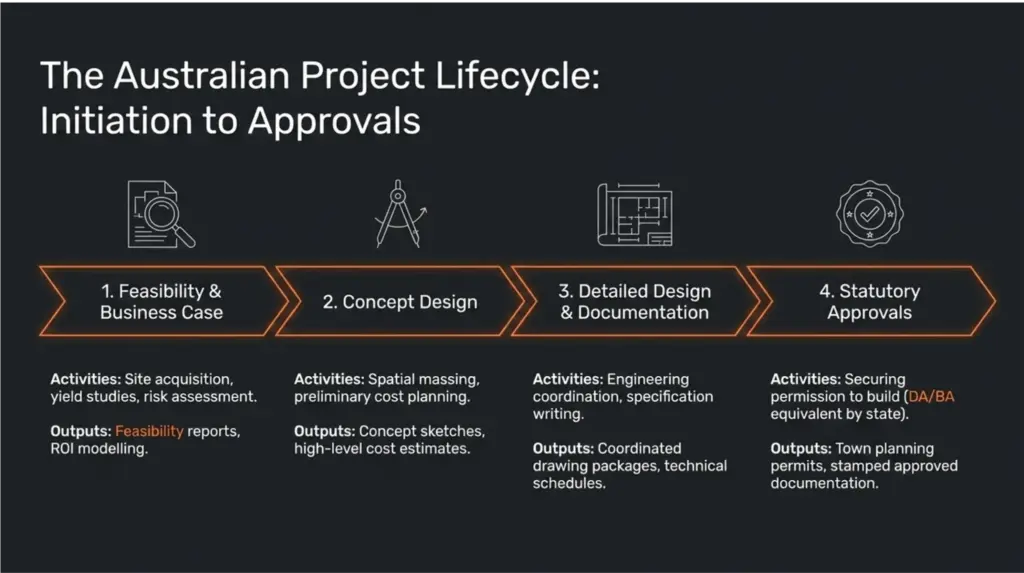
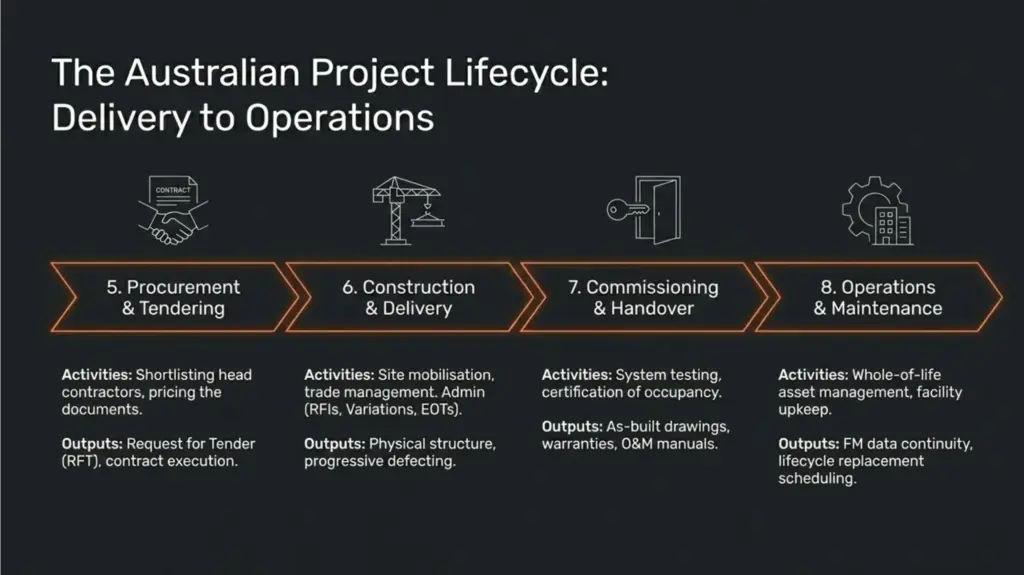
AEC projects in Australia usually move through feasibility, concept design, detailed documentation, approvals, procurement, construction, handover and operations. Each stage we break down below hardens information that the next stage must rely on.
Feasibility & Business Case
Feasibility tests whether the project should proceed before design assumptions become commitments. The feasibility work usually checks whether the project has enough evidence to move into design with controlled assumptions:
- Key activities: Test site constraints, planning pathway, budget assumptions, project brief, risk profile and delivery options.
- Typical documents/data outputs: Feasibility report, options study, early cost plan, risk register, business case and high-level sketches.
Concept Design
Concept design sets the direction that later teams will price, validate and document.
The risk starts when one group treats the design direction as flexible while another treats it as fixed. Once that happens, cost advice, engineering assumptions and planning expectations can move out of step.
Therefore, the concept stage usually tests the decisions that will shape later documentation:
- Key activities: Test spatial options, massing, access, services strategy, structural logic, planning constraints and early cost alignment.
- Typical documents/data outputs: Concept design report, preliminary drawings, massing model, early engineering inputs and high-level cost estimate.
Detailed Design & Documentation
Detailed design converts design intent into coordinated technical information that can be approved, priced or released for construction. This is the stage where unresolved assumptions become visible in drawings, models, specifications and consultant reports.
The documentation work usually focuses on controlling the record before it moves into approval, tender or site use:
- Key activities: Coordinate disciplines, resolve model and drawing conflicts, finalise specifications, prepare approval, tender or construction documentation, and confirm drawing status.
- Typical documents/data outputs: Coordinated drawings, technical specifications, schedules, consultant reports, federated models, issue registers and document transmittals.
Pro tip: When you’re working across federated models, resolving models and drawing conflicts before construction release helps keep coordination issues from moving into procurement, site sequencing, or installation decisions.
Approvals: Planning and Building
Please note that in Australia, the approvals vary by state and territory, so the approval pathway needs to be checked against the project location and asset type. However, you can still expect to:
- Common approval terms: Development Application or Development Approval, planning permit, building permit, building approval, construction certificate and complying development certificate, depending on jurisdiction.
- Evidence/documentation typically required: Architectural plans, planning reports, engineering certificates, fire and access reports, energy efficiency or sustainability evidence, specifications and compliance statements.
Procurement & Tendering
Procurement turns scope into market pricing and delivery obligation. Usually, this phase is where unclear information becomes priced, excluded, or pushed into clarification.
Consider, use these tender workflow below to help you exposes whether the project record is clear enough for the market to price with confidence:
- Issue EOI or shortlist suitable contractors, consultants, or suppliers.
- Prepare and release the RFT package.
- Receive tender queries and issue addenda where the scope needs clarification.
- Review tender submissions, exclusions, assumptions and programme.
- Clarify commercial, technical and delivery gaps with tenderers.
- Negotiate final scope, price, programme and contract terms.
- Award the contract.
Key documents in procurement & tendering phase: RFT scope of works, drawings, specifications, schedules, pricing schedules, tender returnables, proposed contract term.
Construction & Delivery
Construction turns the approved and contracted scope into site work. This is where design decisions, procurement timing and site conditions become visible in the delivery record. The delivery sequence usually moves through:
- Site mobilisation
- Enabling works
- Procurement and material coordination
- Structure or civil works
- Services installation
- Fit-out or finishes
- Inspections and testing
- Completion
Common contract administration items include: RFIs, site instructions, variations, EOTs, progress claims, defects, non-conformance records, inspection and test record.
Commissioning, Handover & Closeout
Commissioning, handover, and closeout prove that the completed asset can operate safely, perform as intended, and be maintained after practical completion.
The risk at this stage is missing documents. Plus, whether the final record gives owners, operators, and facilities teams enough evidence to trust, maintain, and manage the asset.
The handover package usually needs to bring technical evidence, operating information and closeout records into one usable set:
- O&M manuals
- As-built drawings
- Warranties
- Compliance certificates
- Commissioning records
- Test results
- Defects closeout
- Asset registers
- Training records
Operations & Maintenance
Operations and maintenance depend on whether the final asset record remains usable after practical completion.
Facilities and asset teams inherit the building after the project team leaves, so incomplete or poorly structured information becomes an operating problem rather than a documentation issue.
The handover record needs to support maintenance, warranty management, compliance checks and future upgrade decisions:
- FM handover needs: Facilities and asset teams need usable as-builts, asset registers, warranties, maintenance schedules, equipment data, and access to the final approved record.
- Data continuity: Poor handover forces operations teams to rebuild asset knowledge after practical completion.
Trends Reshaping the AEC Industry in Australia Right Now
In 2026, we believe AEC industry trends in Australia are mostly about information control, delivery certainty, and asset performance.
Digital tools matter when they improve how teams coordinate design, price work, verify site progress, manage approvals and hand over usable asset data. Let’s take a look at what those mean in this section.
Digital Engineering & BIM are Becoming Standard Practice
Digital engineering and BIM are becoming standard practice because they connect geometry, project information and coordination decisions.
ISO 19650 describes information management using building information modelling through exchanging, recording, versioning and organising information for all actors, which makes BIM a delivery-control process rather than only a modelling task.
That control only becomes useful when the model supports the decision being made at each BIM project stage:
- Feasibility: Test massing, options, site constraints and early quantities.
- Design: Coordinate disciplines, federate models and review clashes before documentation hardens.
- Procurement: Clarify scope, quantities, packages and tender assumptions.
- Construction: Support sequencing, RFIs, set-out checks and site coordination.
- Handover: Transfer asset information, as-built records and maintainable data into operations.
The maturity level of BIM matters because basic modelling does not automatically create controlled information. Higher maturity requires naming rules, approval gates, issue ownership, model federation discipline and CDE status control.
Especially, when your AEC firm is moving from software use to controlled project delivery, the structured BIM standards, workflows, and rollout planning become part of the implementation question, not a later clean-up task.
BIM decisions carry costs beyond licence pricing because standards, templates, QA routines, training time and coordination behaviour carry much of the implementation effort.
The same model-based workflow only improves delivery when the information is governed well enough to affect cost, risk, programme and safety decisions:
- Cost: Better scope clarity can reduce pricing uncertainty and variation exposure.
- Risk: Clear model status reduces reliance on memory or informal file sharing.
- Programme: Earlier coordination can reduce late rework and avoidable sequencing conflicts.
- Safety coordination: Visual planning and model review can support safer access, staging and workface planning.
Common Data Environments Control Information Sharing
A Common Data Environment supports controlled information sharing by making project status, revision history and approval pathways easier to manage.
The value is in storage, and knowing which information is current, shared, approved, or suitable for construction.
However, that information control in CDE only works when the right project participants use the same information environment:
- Client and asset owner representatives
- Architects and engineers
- Project managers and contract administrators
- Head contractors and subcontractors
- Certifiers or building surveyors where access is required
- Facilities and asset teams during handover
Also, the information inside the CDE needs to show both the work itself and the status of that work:
- Models
- Drawings
- Specifications
- Schedules
- RFIs
- Transmittals
- Approvals
- Issue registers
- Shop drawings
- As-built information
- Handover records.
Digital Twins Support Asset Operations and Maintenance
Digital twins add value after handover when asset data, spatial context and performance information remain connected.
CSIRO describes digital twins as virtual replicas of physical objects, buildings, cities, regions and systems, which makes them relevant to built-asset operations when the data is structured enough to maintain.
That connection becomes useful when it helps operations teams make clearer decisions after handover:
- Asset location and equipment visibility
- Maintenance planning
- Energy and performance monitoring
- Space use analysis
- Scenario testing for upgrades or operating changes
- Fault investigation where sensor or system data is connected.
Reality Capture Supports Progress and Verification
Reality capture supports progress and verification by comparing site conditions against the design or approved record.
Laser scanning, drone capture and site imagery become useful when they are connected to decisions, not stored as another disconnected evidence set. That decision link is what makes reality capture useful across these delivery tasks:
- Existing-condition surveys
- Progress verification
- Tolerance checks
- Defect investigation
- Claims evidence
- As-built validation
- Coordination between site and design teams.
Offsite, modular and prefabrication shift decisions earlier
They depend on whether tolerances, interfaces, services penetrations, transport constraints, and installation sequencing are resolved before fabrication.
That earlier decision point changes how teams need to manage design, supplier coordination, and site readiness:
- Earlier design freeze points
- Stronger shop drawing and approval discipline
- Tighter supplier coordination
- More pressure on dimensional accuracy
- Reduced room for late site adjustment
- Clearer handover evidence for manufactured systems.
Sustainability expectations are rising in Australia
In Australia today, sustainability expectations affect AEC work because performance evidence now has to appear earlier in the project record. Energy, water, embodied carbon, resilience and supplier documentation can influence design, engineering, cost and procurement decisions.
Therefore, we believe NABERS is most relevant where operational performance needs to be measured or improved:
- Energy efficiency
- Carbon emissions
- Water consumption
- Waste produced
- Indoor environment quality, where relevant to the rating type
Green Star also need to consider where the project needs broader sustainability evidence across design, construction, fitout, operations or community outcomes:
- Building design and construction
- Building operations
- Fitouts
- Communities
- Long-term built-environment sustainability categories under Green Star Buildings
For AEC businesses, the sustainability changes documentation timing. Embodied carbon, operational performance, electrification, climate resilience, and supplier evidence need to be considered before procurement locks in materials, systems, and packages.
Conclusion: What the AEC Industry Covers in Australia
AEC means architecture, engineering, and construction working across one built-asset lifecycle, which can be break down to several key points below:
- Who is involved: The Australia AEC ecosystem includes owners, sponsors, operators, architects, engineers, cost consultants, project managers, builders, subcontractors, certifiers and facilities teams.
- Lifecycle: AEC projects usually move through feasibility, concept design, detailed documentation, approvals, procurement, construction, commissioning, handover and operations.
- Standards and regulation: Australian AEC work is shaped by the National Construction Code, state and territory approval pathways, WHS duties, contract requirements and information management standards such as ISO 19650.
- Trends: BIM, CDEs, digital twins, reality capture, prefabrication and sustainability expectations are changing how firms manage information, evidence and delivery risk.
Now, your next step is to study how local rules, roles and digital delivery expectations affect real project work, so consider:
- Career pathways: Research roles such as architectural technician, BIM modeller, BIM coordinator, project administrator, contract administrator, estimator, quantity surveyor, site engineer, services engineer and facilities coordinator.
- Regulation and standards: Review the National Construction Code, state and territory planning pathways, and WHS duties. Also, learn common contract administration terms such as RFI, variation, EOT and practical completion.
- Digital delivery: Learn how BIM workflows, CDE status control, model federation, drawing revisions and handover data fit into Australian project delivery.
- Further reading: Review relevant BIM, NCC, and Interscale AEC glossary to move from general understanding into more specific Australian project research.
FAQs About the AEC Industry in Australia
What is AEC Industry?
AEC industry means the architecture, engineering and construction industry. It covers the people, processes, documents, approvals and delivery work needed to plan, design, build, hand over and operate built assets.
What Sectors and Roles are Included in the AEC Industry?
The roles that include in the AEC industry are architects, engineers, builders, subcontractors, developers, government agencies, certifiers, planners, quantity surveyors, project managers, facilities managers, asset owners, specialist consultants. Australia’s AEC industry also includes commercial, residential, infrastructure, and industrial sectors. .
How is AEC Different from Construction Only?
AEC is broader than construction-only because it includes design, engineering, approvals, procurement, information management, site delivery, handover and operations, while construction mainly refers to physical delivery and site execution.
What is the Project Lifecycle in AEC?
The AEC project lifecycle usually includes Feasibility & Business Case -> Concept Design -> Detailed Design & Documentation -> Planning & Building Approvals -> Procurement & Tendering -> Construction -> Commissioning & Handover -> Operations & Maintenance. Each stage produces information that affects the next stage.
What are Key Standards and Regulations that Affect Australian AEC Work?
Key standards and regulations that affecting Australian AEC works controls include the National Construction Code, state and territory planning systems, WHS duties, contract requirements, sustainability rating systems such as Green Star and NABERS, and information management standards such as ISO 19650.