 Skip to content

Pre-construction BIM services help project teams test design coordination, cost logic, buildability, and information quality before construction begins.
That timing matters on Australian projects because many coordination problems appear before site work, then become expensive once procurement, trade sequencing, or installation has started. For example, a services route may look acceptable in one discipline model until the builder asks how it affects ceiling space, access, and trade sequencing.
The scale of work also matters because coordination pressure grows when more projects, consultants, contractors, and approvals move at the same time.
The Australian Bureau of Statistics reported total construction work done at $83.4 billion in the March quarter of 2026, while Infrastructure Australia’s 2025 Market Capacity Report placed the five-year Major Public Infrastructure Pipeline at $242 billion.
Those figures do not mean every project needs a heavy BIM process. They mean project teams have less room for informal coordination when workloads, stakeholders, and delivery pressure rise together.
This article explains what pre-construction BIM really includes, and what to check before choosing a provider in Australia.
What Is Pre-Construction BIM — and Where Does It Fit in the Project Lifecycle?
Pre-construction BIM is the use of coordinated model information before construction begins to test whether a project can be documented, priced, sequenced, and built with fewer unresolved issues.
Pre-construction BIM usually sits after the early design has enough detail to coordinate, but before major construction decisions become difficult to change. At this point, architecture, structure, services, civil, and specialist inputs may all be moving at different levels of maturity.
As you know, commonly, a model may look complete from one discipline’s view. But, whether it can support the next decision. Can the builder price from it? Can consultants coordinate against it? Can subcontractors understand the spaces they will inherit?
Pre-construction BIM gives those questions a structured place to land:
- In a consultant-led phase, it may support documentation control before tender.
- In a contractor-led environment, it may support trade coordination, early procurement, staging, and constructability review.
- On public infrastructure or asset-heavy projects, it may also support information requirements and handover planning.
For a deeper breakdown of the workflow, Interscale’s guide on what pre-construction BIM includes explains how BIM supports planning, consultant coordination, tender preparation, and the transition into construction.
Core Services Included in Pre-Construction BIM
Core pre-construction BIM services are usually grouped around planning, model coordination, clash and issue management, constructability review, quantity support, sequencing, and information control. But please note that the right scope depends on the project.
For example, a small fitout may need a focused model review. Meanwhile a hospital, school, mixed-use tower, transport package, or industrial facility may need a BIM Execution Plan, structured model exchanges, Common Data Environment rules, and multi-discipline coordination meetings.
The BIM scope should follow the decisions the project team needs to make before construction begins. That is why the service mix should be judged by decision support.
| Service | What it includes | What the buyer should check |
| BIM planning and execution setup | BIM uses, deliverables, roles, naming rules, exchange points, and review cadence | Whether the BIM scope matches the contract, team structure, and project milestones |
| Model setup and federation | Revit, IFC, Navisworks, or Autodesk Construction Cloud setup across disciplines | Coordinates, shared origin, version status, discipline responsibility, and model purpose |
| Clash detection and issue management | Spatial, clearance, access, and coordination checks | Clash tolerances, test sets, priority rules, issue ownership, and closeout method |
| Constructability review | Buildability, staging, access, installation, and sequencing checks | Whether findings are ranked by site impact rather than model neatness |
| Quantity and tender support | Model-based quantities and early estimating inputs | Which quantities are reliable and which still need manual validation |
| 4D sequencing | Linking model elements or zones to programme activities | Whether the sequence reflects actual site access and trade flow |
| Information and handover management | CDE rules, status codes, revision control, and asset information planning | Whether the workflow supports ISO 19650-style information control |
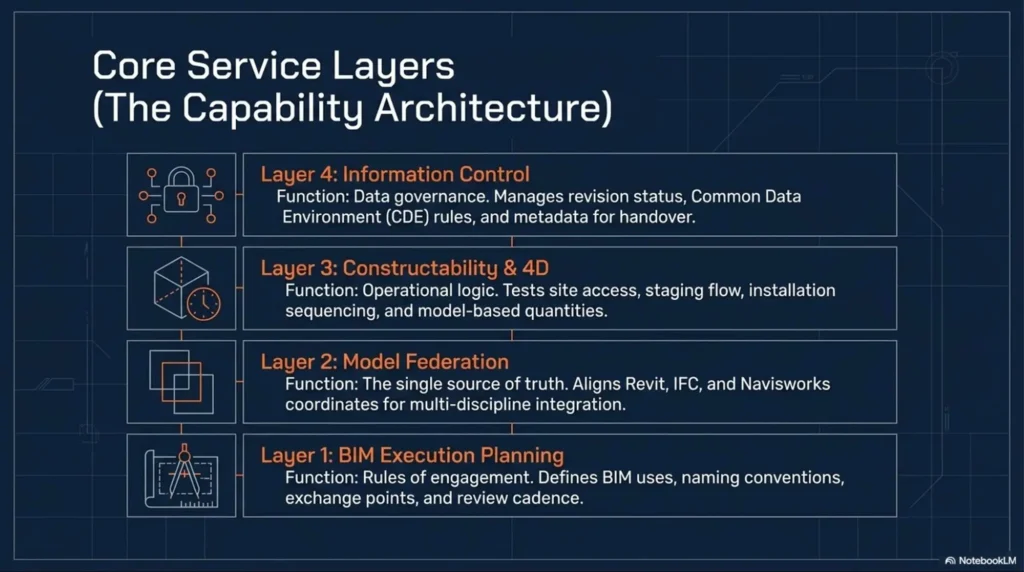
This is where many buying conversations become blurry. Two providers may both say they offer BIM modelling, but one may only deliver geometry while another may define model purpose, manage issue status, check model quality, and support downstream information use. Knowing how to evaluate a BIM service provider on process, not portfolio, keeps that conversation specific.
BIM Planning and Execution Setup
BIM planning defines what the model must support before time is spent creating unnecessary detail.
Because some projects need coordination. Others need tender support, quantity checks, 4D sequencing, trade coordination, or handover data. Each use needs a different level of model detail and information reliability.
The BIM Execution Plan turns that intent into working rules. It should define authorship, exchange timing, naming conventions, file status, review cadence, approval gates, issue escalation, and model acceptance criteria.
One good signal to look for is whether the provider asks what decisions the model needs to support before requesting files.
Model Setup, Federation, and Coordination
Model setup and federation give separate discipline models a controlled environment for coordination.
Here, the coordination becomes visible. Structure may still be resolving penetrations. Mechanical and electrical services may be competing for the same space. Fire, hydraulic, façade, and specialist systems may add access or maintenance requirements that are easy to miss in separate drawings.
The provider should confirm shared coordinates, model origin, discipline separation, version status, file naming, and model purpose before coordination begins. If those basics are wrong, clash detection can create noise rather than clarity.
Let’s say a civil consultant working across Revit, Civil 3D, IFC, and contractor-side platforms may need clear file exchange rules. That’s why, before coordination begins, the team should confirm:
- Which model is current
- Which information is approved
- Which file is shared for review only
- Who resolves file exchange issues
Clash, Constructability, Quantity, and Sequencing Support
Clash, constructability, quantity, and sequencing support help the team test whether the coordinated model can support real project decisions.
However, a raw clash report can be overwhelming. Good coordination separates hard clashes, soft clearance issues, access problems, maintenance zones, sequencing conflicts, and tolerable overlaps. Each issue needs an owner, location, priority, due date, status, and decision record.
Constructability review adds another layer. It checks whether the model logic works against staging, installation, access, maintenance, and trade flow. That matters because a model can be spatially coordinated but still difficult to build.
Quantity and 4D BIM support need the same discipline. If the model is being used for cost support, the project team needs to know whether it is suitable for pricing or only coordination. If it is being used for sequencing, the visual output must reflect actual site access and trade flow.

Information and Handover Management
Information and handover management keep the model useful after coordination meetings are finished. This includes CDE rules, model status, revision control, issue records, asset information, and handover requirements.
These details can feel administrative early in the project, but they become critical when the team needs to confirm which information is approved, shared for review, or ready for downstream use.
A provider should be able to explain how information will move through the project, not only how the model will be produced.
How Pre-Construction BIM Reduces Costly Rework on Australian Projects
Pre-construction BIM reduces rework by finding coordination problems, information gaps, and sequencing conflicts before they become site instructions, redesign loops, or trade delays.
As we all know, rework is costly because one missed issue can affect more than the drawing set. And to your reference, Australian construction research by Peter Love found mean direct and indirect rework costs at 6.4% and 5.9% of contract value.

This kind of rework data gives useful context for why coordination errors deserve attention before construction begins. The table below shows where those risks usually appear and how pre-construction BIM can help teams catch them earlier.
| Where BIM helps | What it reduces | What the team should check |
| Spatial coordination | Clashes around structure, ceiling spaces, risers, plant rooms, and service routes | Whether conflicts are found before trade pricing or installation |
| Information control | Teams working from different drawings, models, schedules, or revisions | Whether the latest approved information is clear to everyone |
| Decision clarity | Vague coordination comments with no owner or deadline | Whether each issue has an owner, priority, status, and next action |
| Programme planning | Sequencing conflicts that affect access, shutdowns, or trade flow | Whether the model reflects actual site constraints |
As you might expect, the main value is timing. A services clash found before tender may become a model issue, a consultant response, and a revised layout. The same clash found after installation may require redesign, new materials, programme changes, and commercial negotiation.
Pre-construction BIM does not remove all rework. Latent conditions, authority comments, design changes, and procurement substitutions can still affect delivery. Its value is in reducing avoidable issues that become expensive because they are found too late.
Australian Standards and Compliance Requirements for Pre-Construction BIM
Australian pre-construction BIM should align with AS ISO 19650-style information management, NATSPEC BIM guidance, client requirements, and any state or project-specific digital engineering rules.
In pre-construction, the practical value is simple: the team needs to know how information is named, checked, shared, approved, revised, and handed over.
The table below turns those information-management requirements into the checks a buyer can use during provider selection.
| Requirement area | What it controls | What the buyer should check |
| BIM Execution Plan | Model uses, roles, exchange points, and review cadence | Whether the BEP matches the contract, milestones, and project team structure |
| Naming and status rules | File naming, revision control, and approval state | Whether teams can tell what is approved, shared for review, or still in progress |
| Common Data Environment | Where models, drawings, issues, and records are stored | Whether the CDE works as a controlled workflow, not just a folder system |
| Responsibility matrix | Who authors, checks, approves, and responds to model information | Whether issue ownership is clear before coordination starts |
| Asset information requirements | Handover data and maintainable asset records | Whether handover needs are considered before model setup is locked |

Pro tip: Government and infrastructure projects may add stricter digital engineering expectations around metadata, approvals, reporting, and handover information, one of the key differences between infrastructure and building BIM. Therefore, a provider should be able to explain how those requirements work inside the live project routine, not only inside a compliance document.
When Should You Engage Pre-Construction BIM Services? (And When It May Not Be Necessary)
You should engage pre-construction BIM services when coordination risk, stakeholder complexity, model requirements, or delivery pressure exceed what the internal team can manage safely.
The decision is easier when you separate projects that need structured BIM support from projects that only need light review. Let’s break down.
You Should Engage Pre-Construction BIM Services When
Pre-construction BIM services are most useful when unresolved coordination issues could affect pricing, procurement, approvals, programme certainty, or site work. You can usually spot the need of pre-construction BIM services through conditions like:
- Multiple disciplines sharing tight spaces
- Complex services coordination
- Contractor-led trade coordination before procurement
- Staging that affects access, shutdowns, safety, or trade flow
- Public-sector or infrastructure digital engineering requirements
- Model outputs needed for tender, quantity, or handover decisions
- Internal BIM management capacity already stretched
For example, a builder may engage pre-construction BIM before subcontractor appointment to reduce ambiguity around ceiling zones, risers, plant rooms, penetrations, and structural openings. Those openings settle faster when outsourced structural BIM services already keep a current frame model the builder can coordinate against.
Pre-Construction BIM Services May Not Be Necessary When
Pre-construction BIM services may add less value when the coordination risk is low and the cost of formalising the process outweighs the risk it removes. So, pre-construction BIM services usually not be necessary in simpler project conditions such as:
- Small tenancy refreshes
- Simple projects with limited services changes
- Projects with low coordination risk
- Scopes already resolved through conventional documentation
- Situations where a light model check is enough
For better decision you really need pre-construction BIM services or not, you should check what happens if an unresolved issue is found later:
- If the issue would be cheap and easy to fix, keep the BIM scope lean.
- If it could affect structure, services, procurement, approvals, or programme certainty, bring BIM support forward.
How to Choose a Pre-Construction BIM Service Provider in Australia
Choose a pre-construction BIM service provider by testing how well they understand project risk, information management, coordination routines, and Australian delivery conditions.
Once standards define how information should move, provider selection becomes more about who can keep decisions traceable. That’s why the provider should be able to explain issue ownership, model exchange, CDE structure, standards alignment, clash filtering, quality checks, and handover implications.
Use the table below to compare pre-construction BIM service providers in Australia.
| Selection area | What to ask | Strong answer sounds like | Proof to request |
| Project fit | Have you supported similar project types and delivery models? | They explain relevant workflows without treating every project the same | Example scope, project workflow, or delivery approach |
| BIM scope control | What should and should not be modelled? | They reduce unnecessary modelling while protecting key decisions | A scope breakdown that separates coordination, pricing, sequencing, and handover needs |
| Coordination method | How are clashes tested, filtered, assigned, and closed? | They explain test sets, tolerances, priorities, and owner assignment | A sample issue workflow from detection to closeout |
| Standards alignment | How do you support ISO 19650-style or NATSPEC-aligned workflows? | They connect standards to BEPs, naming, status, CDE rules, and exchange points | A sample BEP structure, naming rule, or CDE workflow |
| Software stack | Which tools can you work across? | They discuss Revit, Navisworks, ACC, IFC, Procore, or other tools based on the project | A file exchange or platform workflow showing where approved information lives |
| Reporting and QA | What does a coordination report include, and how is model quality checked? | They show review checkpoints, model health checks, and decision-ready reporting | A sample coordination report or model QA checklist |
The strongest provider conversations usually come down to proof: how issues move, where approved information lives, and whether the model supports the decisions your project needs before construction begins.
Where Interscale Fits in the Pre-Construction BIM Workflow
Pre-construction BIM becomes valuable when the model helps a project team make cleaner decisions before site pressure begins. That is where Interscale can support Australian AEC teams.
Interscale BIM services in Australia cover consulting, implementation, management, coordination, and content creation across project delivery workflows.
Our BIM service fits projects where model governance, coordination routines, issue tracking, software alignment, and tender readiness need to work together before construction begins.
For a deeper breakdown, you can book a free discussion session with an Interscale BIM expert.
In that discussion, we can help you mapping how to turn model coordination into a clearer pre-construction BIM workflow, so your team can see what needs to be resolved before tender, procurement, or site work begins.

FAQ
How Long Does Pre-construction BIM Typically Take on an Australian Project?
Can Pre-construction BIM Services Integrate with Existing Project Management Tools, Such as Procore or Autodesk Construction Cloud?
Sources:
- Australian Bureau of Statistics. Construction Work Done, Australia, Preliminary, March 2026. https://www.abs.gov.au/statistics/industry/building-and-construction/construction-work-done-australia-preliminary/latest-release
- Infrastructure Australia. 2025 Infrastructure Market Capacity Report. https://www.infrastructureaustralia.gov.au/2025-infrastructure-market-capacity-report
- NATSPEC. AS ISO 19650. https://bim.natspec.org/resources/bim-topics/40-as-iso-19650
- NATSPEC. NATSPEC National BIM Guide. https://bim.natspec.org/documents/natspec-national-bim-guide
- Queensland Government. BIM Projects — Data and Information Guideline. https://www.forgov.qld.gov.au/information-technology/queensland-government-enterprise-architecture-qgea/qgea-directions-and-guidance/qgea-policies-standards-and-guidelines/bim-projects-data-and-information-guideline
- Love, P. E. D.. Calculating Total Rework Costs in Australian Construction Projects. https://www.tandfonline.com/doi/abs/10.1080/10286600500049904](https://www.tandfonline.com/doi/abs/10.1080/10286600500049904


