 Skip to content

A BIM construction service helps project teams make model information reliable enough to use during design coordination, tendering, construction planning, and handover.
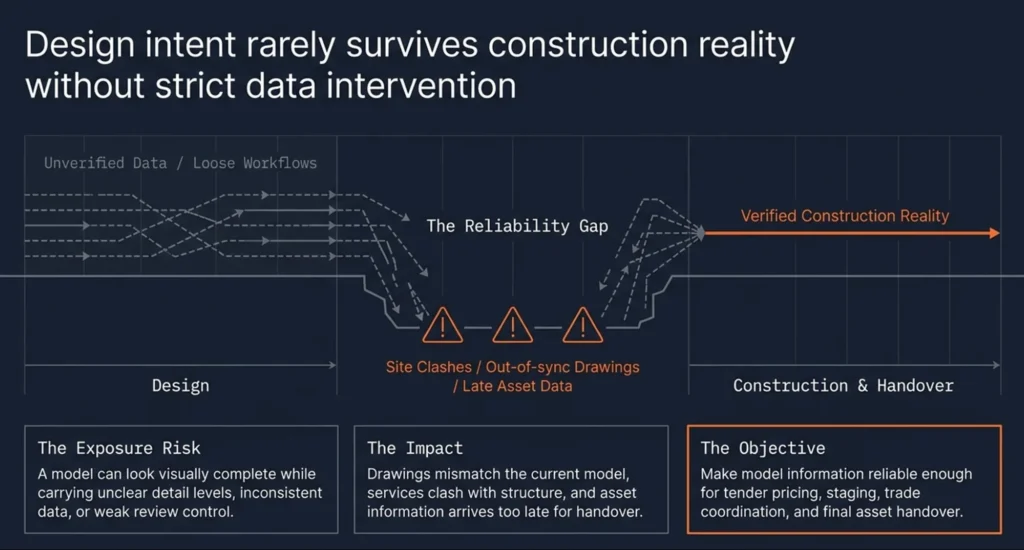
That reliability matters once a project moves beyond design intent. Architects, engineers, builders, subcontractors, and asset owners may all rely on the same model, but not for the same decision. A model can look complete while still carrying unclear detail levels, inconsistent data, or weak review control.
The question now is whether the provider can support the part of the information workflow that is creating risk. That may be documentation capacity, consultant coordination, model QA, construction sequencing, or asset handover.
Let’s break down the BIM construction service in the article below.
What are BIM Construction Services?
BIM construction services are specialist services that help project teams create, manage, coordinate, and check building information models during construction delivery. Depending on the project stage and delivery need, these BIM construction services can include:
- Revit modelling and documentation
- BIM coordination and clash detection
- model audits and QA reviews
- Revit family and content creation
- 4D sequencing and construction staging
- 5D quantity and cost-support workflows
- CDE setup and model exchange support
- ISO 19650-aligned information management
- Asset data and handover preparation
The purpose of BIM construction services is to make model information reliable enough for design review, tender coordination, construction planning, trade coordination, and asset handover.
As mentioned earlier, not every project needs the same BIM support. A design team may need documentation help, a builder may need coordination support, and a subcontractor may need model information that is ready for installation planning.
Core BIM Services Used in Construction Projects
Core BIM services usually cover modelling, coordination, documentation, management, content creation, sequencing, and handover support. Let’s break down the core BIM services in the table below.
| BIM service | What it includes | What the buyer should check |
| Revit modelling | Architecture, structure, MEP, or interiors model creation | Discipline scope, LOD, coordinates, inputs, and model use |
| Revit documentation | Drawing sheets produced from a controlled Revit model | Sheet standards, view templates, schedules, annotations, and QA |
| BIM coordination | Federated review across consultants, trades, and builder teams | Coordination cadence, issue ownership, CDE workflow, and closeout rules |
| Clash detection | Spatial and physical conflict checks before site work | Clash tolerance, test sets, false clash filtering, and report format |
| Model audits and QA reviews | Review of model health, compliance, warnings, and setup quality | Audit checklist, parameters, naming, views, sheets, and issue categories |
| Revit family and content creation | Reusable model objects, content libraries, and project-specific components | Parameters, naming rules, category setup, file size, and project standards |
| 4D sequencing | Linking model elements to construction staging or programme logic | Programme quality, staging logic, package breakdown, and update ownership |
| 5D quantity support | Using model information to support quantity and cost workflows | Measurement rules, model reliability, quantity outputs, and estimator review |
| ISO 19650-aligned information management | BIM responsibilities, model exchange, CDE rules, approvals, and handover structure | BEP, naming rules, approval gates, information requirements, and handover format |

The easiest way to understand these services is by project dependency. Some services create model information. Others check, coordinate, or govern that information so the wider project team can rely on it.
If the dependency is misunderstood, the wrong service gets purchased. A team may buy modelling hours when it actually needs a model audit. A builder may run clash detection when the real issue is that no one owns the issue closeout.
A useful provider will not push every service at once. They should identify whether the risk sits in production capacity, coordination control, model quality, or information handover.
That’s why Interscale’s BIM services fit this early scoping conversation because they cover BIM consulting, management, coordination, audits, modelling, and Revit content support for Australian AEC teams.
How BIM Services Improve Construction Outcomes
BIM services improve construction outcomes by reducing uncertainty before project information reaches site.
The value usually appears at handoff points, where designers issue updated models, engineers revise discipline information, head contractors review constructability, subcontractors plan installation, and asset owners expect usable handover data.
If the workflow is loose, drawings may not match the current model, services may clash with structure, or asset information may arrive too late for handover.
The sections below show where BIM services create the most practical value during construction delivery.
Earlier Coordination
BIM coordination improves construction outcomes by identifying model conflicts before they become site issues.
A useful coordination process does more than produce a raw clash list. It groups issues by location, discipline, priority, and action owner, then separates real construction conflicts from low-value model noise.
For a head contractor preparing a D&C tender, this can support pricing, staging, and clarification decisions before assumptions harden.

Cleaner Documentation
Revit documentation support improves construction outcomes by keeping drawings, schedules, sections, and annotations aligned with the model.
This is valuable during deadline peaks, when internal teams may understand the design intent but need production support to keep large drawing packages consistent. The external role should support internal review, not replace professional judgement.
Better Model Governance
BIM management improves construction outcomes by controlling how model information is produced, exchanged, reviewed, and approved.
That can include naming rules, coordinates, revision control, templates, shared parameters, issue tracking, and handover rules. Without that control, coordination meetings often become status clarification sessions instead of issue-resolution sessions.
More Useful Handover Information
BIM services improve construction outcomes by making handover information usable after the build is complete. A handover model should not become a visual archive. It should carry relevant asset data, documentation links, classification fields, and maintainable information where required by the project.
This needs to be defined early. If asset requirements are discussed near practical completion, the team may need to rebuild information when the project is already under closeout pressure.
BIM Construction Services and ISO 19650 in Australia
ISO 19650 helps Australian project teams manage BIM information in a structured and consistent way. It matters when consultants, builders, subcontractors, and asset owners need to produce, exchange, review, and approve information inside one controlled workflow.
Practically, for BIM construction services, ISO 19650 usually means knowing how to manage:
- Exchange information requirements: What information must be delivered, by whom, and at which project stage.
- Model production responsibilities: Who creates, updates, reviews, and approves each model output.
- Common data environment rules: Where files are issued, how revisions are controlled, and how project teams access current information.
- Naming and model exchange rules: How files, views, models, and deliverables are named so teams do not lose time checking versions.
- Review and approval workflows: How model information moves from draft issue to coordination review, approval, or handover.
- Handover requirements: What asset information needs to be captured before the project reaches closeout pressure.

These information management rules become more important when external BIM support is involved. Outsourced teams work better when the brief defines what information is required, where it should be issued, how files should be named, and who approves the output.
For example, a civil consultant working across Revit, Civil 3D, Navisworks, IFC, and PDF deliverables may not need a full ISO 19650 implementation. The team may still benefit from ISO-aligned naming, model exchange, and review rules. Use the standard to reduce ambiguity, not to create admin for its own sake.
In-House BIM Team vs. Outsourced BIM Services: What’s Right for Your Project?
An in-house BIM team gives stronger day-to-day control, while outsourced BIM services give flexible capacity and specialist support. The right choice depends on workload shape, project complexity, internal skill depth, and how much BIM responsibility your organisation wants to retain. For Revit-heavy production, outsourced Revit modelling is the most common flexible option.
The table below compares in-house BIM team vs. outsourced BIM services vs. hybrid options before deciding whether to hire, outsource, or use a hybrid model.
| Option | Best fit | Main strength | Main risk |
| In-house BIM team | Ongoing BIM-heavy delivery | Control, continuity, and internal knowledge | Hiring cost and utilisation gaps |
| Outsourced BIM service | Deadline peaks or specialist tasks | Flexible capacity and technical depth | Poor scoping can create rework |
| Hybrid model | Growing teams with uneven workload | Internal ownership plus external support | Needs clear role boundaries |
Choose an In-House BIM Team if
An in-house BIM team usually makes sense when BIM is part of your delivery model every month. Consider choosing in-house BIM team option if:
- Your BIM workload is consistent: projects regularly require BIM modelling, coordination, documentation, or management.
- Your standards are already mature: templates, naming rules, QA checks, and model workflows are used across multiple projects.
- Your team needs close design control: model decisions are closely tied to design intent, approvals, and client communication.
- Your utilisation is high enough: BIM managers, coordinators, and modellers have enough ongoing work to justify the internal cost.
An in-house BIM team fits when your business needs close control over model standards, design intent, internal QA, and client-specific delivery habits.
Choose Outsourced BIM Services if
Outsourced BIM services usually make sense when the workload rises around specific project stages.
This rising workload can include tender submissions, documentation deadlines, consultant coordination, Revit production backlogs, model audits, or handover preparation. That’s why choose this outsourced BIM services option if:
- Your workload comes in peaks: BIM pressure increases during tenders, submissions, coordination cycles, or closeout.
- You need specialist support: the project requires model auditing, clash detection, 4D sequencing, Revit content, or ISO-aligned information management.
- Your internal team is at capacity: staff can review and approve work, but need extra production or coordination support.
- The task can be clearly scoped: the provider can work from defined inputs, LOD requirements, QA rules, and deliverables.
Choose a Hybrid BIM Model if
A hybrid BIM model usually works best when internal staff should retain ownership, but external support can help with defined parts of the workflow. Hybrid option is often the practical middle ground for Australian AEC teams with uneven BIM demand.
So, choose this hybrid BIM model option if:
- You need internal ownership: design intent, approvals, client context, and standards should stay with your team.
- You also need flexible capacity: external support can help during documentation peaks, tender deadlines, or coordination-heavy stages.
- You can separate responsibilities clearly: internal staff own decisions, while external specialists support modelling, audits, documentation, or coordination.
- You want to build capability gradually: outsourcing can support delivery while your internal BIM standards, templates, and QA habits mature.
What to Look for When Choosing a BIM Construction Service Provider in Australia
A good BIM construction service provider should understand construction delivery and be able to explain how they handle construction-stage decisions, LOD requirements, QA checks, coordination workflows, and Australian CDE rules before the work starts. The same checks apply when choosing BIM services for design or coordination work, not just construction.
Use the five checks below to separate practical BIM delivery support from basic model production.
Construction-stage Understanding
The provider should understand how design information becomes construction information before it affects site decisions. Ask how they handle issues that influence constructability, coordination priority, discipline ownership, and review timing.
Weak answers usually stay at the level of “we produce accurate models.”
Clear LOD and Information Requirements
The provider should define the level of detail and level of information needed for the task. A model for design review is different from a model used for trade coordination or asset handover. If LOD is not agreed early, the provider may model more detail than the project needs or less detail than coordination requires.
The provider should also separate geometry from information. A visually detailed model may still be weak if the parameters, classification, or asset data are incomplete.
Visible QA Process
The provider should show how model quality is checked before anything is issued. That may include model health checks, view template checks, parameter reviews, clash test validation, drawing QA, naming audits, and issue logs.
Ask what the provider checks, who checks it, and what happens when the model fails that check.
A low quote may simply remove time from setup, review, or revision control. That may be acceptable for a narrow drafting task. It becomes risky when the provider is expected to coordinate across disciplines.
Coordination Workflow Maturity
The provider should know how coordination issues are grouped, assigned, reviewed, and closed.
Please remember, the clash detection is only useful when the project team can act on the findings. On many Australian projects, coordination issues may depend on design authority, cost impact, programme risk, and buildability. On steel and precast packages, ask how a provider runs structural BIM constructability review before shop drawings start.
Australian Delivery Context and CDE Fit
Of course, the provider should understand Australian tender habits, consultant roles, contractor expectations, approval pathways, handover requirements, and builder-controlled CDEs.
Tool fit may include Revit, Navisworks, Autodesk Construction Cloud, BIM 360, AutoCAD, Civil 3D, Revizto, Solibri, IFC workflows, or contractor-controlled document environments. This matters because BIM work often fails at exchange points.
A novated design handoff can change responsibility, a contractor-led coordination meeting can change issue priority, and an asset owner requirement can change what data needs to be captured from the start.

Questions to Ask a BIM Service Provider Before You Sign
The best questions to ask a BIM service provider are the ones that reveal delivery control, model ownership, and how the provider handles uncertainty.
The table below gives you the questions that separate practical BIM delivery support from a provider that only talks about capability.
| Question | What the answer should reveal |
| What inputs do you need before starting? | Whether the provider asks for models, drawings, BEP, templates, coordinates, standards, and known issue history |
| How do you define LOD or level of information needed? | Whether model detail, parameters, and asset data are tied to the model’s actual use |
| Who owns model decisions? | Whether design intent, approval responsibility, and issue sign-off stay clear |
| How do you manage model QA? | Whether checks happen before issue, including model health, naming, parameters, views, sheets, and warnings |
| How do you report coordination issues? | Whether clashes are grouped by location, discipline, priority, owner, and closeout status |
| What happens when consultant information changes? | Whether revision control, rework rules, and change tracking are agreed upfront |
| Can you work inside our CDE? | Whether the provider can follow formal transmittals, issue workflows, permissions, and approval gates |
| How do you price variations? | Whether added disciplines, new inputs, faster deadlines, extra revisions, and CDE requirements are handled clearly |
| What does handover include? | Whether deliverables include native files, IFC, PDFs, issue logs, QA notes, asset data, and agreed handover formats |
| Who will be our day-to-day contact? | Whether there is a responsible BIM lead who can interpret project intent, not only a production team |
Pro tip: Use the first meeting to test whether they can work inside your project environment before deadlines, coordination issues, or handover pressure expose the gaps.
What BIM Construction Services Cost in Australia
BIM construction services in Australia can range from about A$50 to $200 per hour for Revit drafting support, while more senior BIM coordination or management work often costs more depending on discipline scope, project complexity, and delivery responsibility. Those price gaps make more sense once you see how BIM coordination and management roles differ in scope and seniority.
As a practical cost signal, some Australian Revit drafting providers list hourly rates around $60 to $150, depending on project complexity, discipline, and level of detail.
That is why a single fixed number can be misleading. A narrow drafting task may only involve model updates or drawing production. A coordination-heavy scope may include clash test setup, issue reporting, CDE workflows, revision control, meetings, and QA before issue.
Most providers price BIM work through hourly rates, fixed-fee packages, retainers, or project-based scopes.
| Pricing model | Best fit | Buyer caution |
| Hourly rate | Audits, advisory, small tasks, unclear inputs | Requires active budget control |
| Fixed fee | Defined modelling or documentation packages | Inputs and exclusions must be precise |
| Retainer | Ongoing coordination or production support | Needs workload planning |
| Project-based | BIM delivery across a defined project stage | Variation rules must be agreed early |
Plan Your BIM Construction Support With Interscale
Interscale BIM management support helps your teams plan BIM construction support around real project pressure. That may involve improved model coordination, review workflows, CDE use, and delivery control during active project stages.
Our first step is to define what needs support. Because some teams need Revit production help. Others need stronger model QA, cleaner coordination, or maybe your team need a better BIM management process.
That’s why Interscale can work alongside your internal team to shape the right support model for the project stage.
Book a free discussion session with Interscale to review your BIM workload, current constraints, and the most practical next step.


