
Key Takeaways
- AEC firms carry shifting risk each time drawings, models, or approvals move between parties.
- Operational performance depends on keeping people, process, technology, and governance aligned across every project phase.
- Most delivery failures occur at handoff points where information is current for one party but not yet confirmed for the next.
An AEC firm is a business that delivers architecture, engineering, construction, or related project services across the built environment.
In Australia, the definition is shaped by more than discipline. An AEC firm is shaped by how responsibility moves from brief to design, then into tender, construction, and handover.
For small to mid-sized practices, the real operating question is how well that responsibility is recorded and controlled. Risk shifts each time information is issued, approved, revised, or relied on by another party.
This article details the delivery mechanics for small to mid-sized practices, identifying where operational friction occurs and demonstrating how to improve the commercial outputs of an AEC firm.
What is an AEC firm?
An AEC firm is an organisation that provides architecture, engineering, construction, or related advisory services for built assets.
The AEC firm may work on buildings, infrastructure, industrial facilities, fit-outs, public assets, or refurbishment programmes. Each AEC firms’ role is defined not only by discipline, but by the responsibility it accepts when information is issued, approved, priced, built, or handed over.
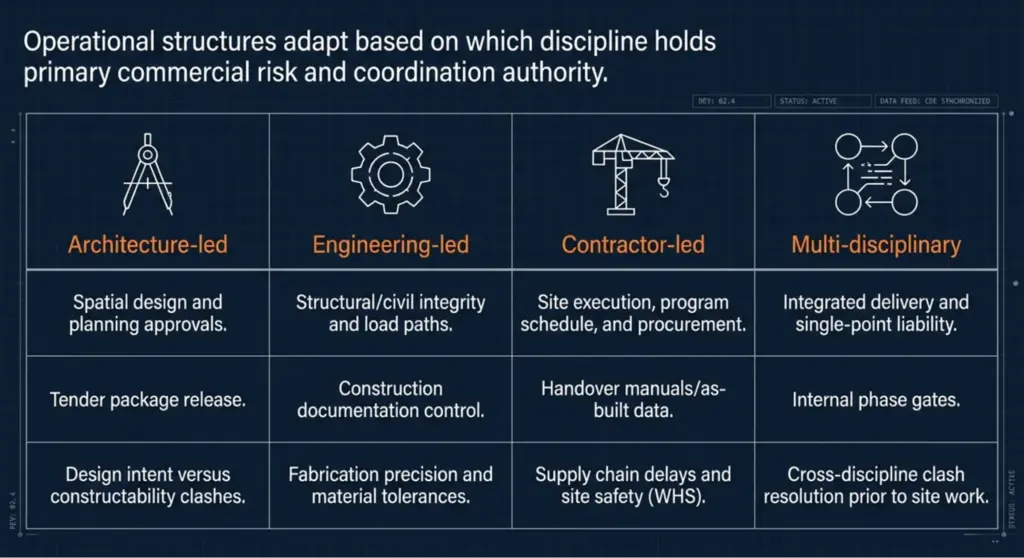
AEC services can span feasibility input, design, documentation, engineering analysis, BIM coordination, procurement support, construction management, handover information, and asset refurbishment planning.
Some firms stay close to one discipline. While others AEC firms combine design, engineering, project management, digital delivery, sustainability, or construction advisory into a more integrated operating model.
A private firm in the AEC sector is usually judged by more than technical capability. Clients and project partners need to know which responsibilities the private AEC firm can hold, how its outputs are controlled, and where its role begins and ends.
That boundary matters because risk shifts each time a drawing, model, specification, report, or approval moves to another party.
| Firm type | Core focus | Typical risk profile |
| Architecture-led | Design intent, spatial coordination, approvals, documentation | Design liability, coordination gaps, and documentation quality |
| Engineering-led | Structural, civil, services, geotechnical, or technical design | Technical performance, compliance, and certification responsibility |
| Contractor-led | Site execution, buildability, procurement, subcontractor delivery | Cost, schedule, safety, and construction sequencing |
| Multi-disciplinary | Integrated design, engineering, advisory, and digital delivery | Cross-discipline coordination and internal authority control |
| Program management | Portfolio oversight, governance, reporting, and delivery controls | Schedule, budget, stakeholder, and financial governance |
How an AEC Firm Operates Across a Project Lifecycle
An AEC firm operation works best when people, process, technology, and governance stay aligned from early briefing through to handover. Here the four operating controls:
- People: People hold responsibility for design decisions, technical checking, coordination, approvals, and issue control.
- Process: Process defines how work moves from brief to design, then into tender, construction documentation, and handover.
- Technology: Technology stores, exchanges, and checks project information across models, drawings, schedules, PDFs, and common data environments.
- Governance: Governance decides what is approved, revised, rejected, issued, or escalated at each release point.
However, the operating challenge is not only producing design or construction information. The challenge of an AEC firm’s operation is making sure each project phase passes forward information that is current, approved, and usable by the next party.
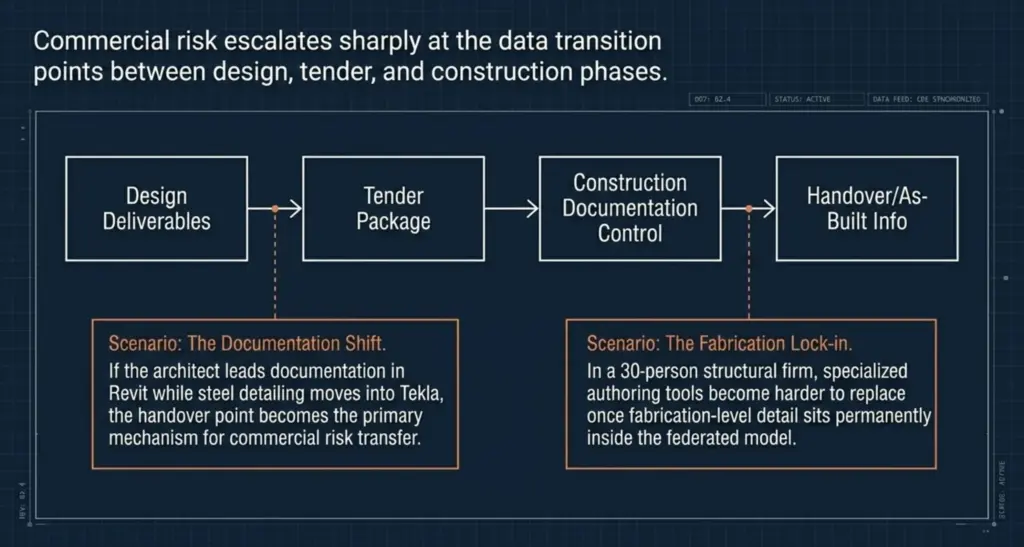
Then, the lifecycle usually starts with briefing, feasibility, and early design. In Australia, those outputs must eventually support statutory and project requirements, including the National Construction Code’s performance-based framework for safety, health, amenity, accessibility, and sustainability.
| Phase | Main output | Key handoff risk |
| Briefing and feasibility | Scope assumptions, site constraints, budget inputs, approval pathway, early responsibility matrix | Scope starts moving before decision authority, exclusions, and consultant responsibilities are clear |
| Concept and design development | Discipline models, drawings, design reports, coordination notes, issue register, early cost inputs | Teams coordinate from partially aligned information before design decisions are confirmed |
| Tender documentation | Tender drawing set, specifications, schedules, clarifications, pricing assumptions | Tenderers price from documents that may not clearly separate approved scope, provisional items, and unresolved design issues |
| Construction documentation and site support | Issued-for-construction drawings, model extracts, revisions, RFIs, site instructions, change records | Approved design, revised information, and field variation become hard to separate without release control |
| Handover | As-built records, O&M manuals, warranties, certificates, asset data, defect records | Final records fail to match the approved construction record, making maintenance, claims, or compliance evidence harder to prove |
Please note that each handoff changes the commercial meaning of project information. A model or drawing may be suitable for coordination at one stage, but not yet suitable for tender, construction, or handover.
That is why release gates matter. They determine which record can be relied on, who carries authority, and where risk moves next..
Common Operational Challenges in AEC firms
Common operational challenges in AEC firms usually start when project information changes faster than the team can control it, and usually show up in coordination, document control, change management, and QA/WHS:
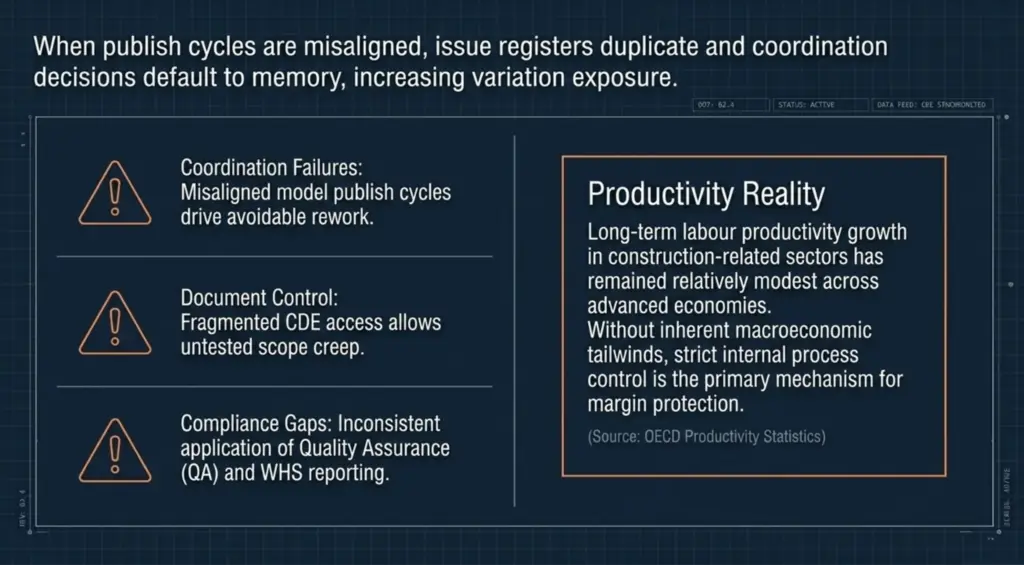
- Coordination failures and rework: When design teams publish at different times, issue registers duplicate or miss resolved items. Coordination decisions then depend on memory instead of the common data environment.
- Poor document control: When drawings, models, PDFs, and site instructions carry different revision status, teams cannot clearly separate approved information from work still under review.
- Scope creep and change management gaps: Informal comments become commercial risk when the approval path does not show who accepted the change, what it affects, and whether fee or programme has shifted.
- Inconsistent QA and WHS discipline: Safe Work Australia’s model WHS laws place duties on PCBUs to manage risks. In practice, quality checks, readiness evidence, and safety controls need to sit inside delivery discipline, not late-stage paperwork.
Why Improving an AEC Firm Cannot Rely on Tools Alone?
Improving an AEC firm cannot rely on tools alone because productivity gains depend on how work is coordinated, reviewed, approved, and issued.
The OECD Compendium of Productivity Indicators 2025 estimated labour productivity growth at around 0.4% in 2024 across OECD countries excluding Türkiye, after a modest rebound to 0.6% in 2023.
The OECD figure does not explain every AEC delivery problem, but it gives useful context. Productivity improvement still has to be created inside the way work is coordinated, reviewed, approved, and issued.
For an Australian AEC business, process and digital improvement need to be tied to real delivery points. A new platform may speed up storage, search, or visibility. It does not reduce waste if review gates, approval roles, naming rules, change records, and commercial triggers remain unclear.
Construction fragmentation makes this more visible in daily delivery. It shows up in ordinary places: a consultant upload, an unresolved RFI, a late subcontractor drawing, or a handover file that does not match the issued record.
The best response is to check whether the systems already in use support status control, authority control, and evidence control before adding another platform.
In cases where multiple platforms or disconnected tools are creating friction between teams, targeted BIM integration and workflow optimisation can help connect systems, reduce manual handling, and maintain a consistent source of truth across project stages.
How to Improve an AEC Firm: 7 Practical Levers
To improve an AEC firm, consider to focus on seven practical levers: quality, information status, change control, planning rhythm, supplier management, measurement, and capability.
This section breaks down each practical lever by the part of delivery control it strengthens.
Standardise Delivery With a QMS
Quality Management System (QMS) standardises delivery by giving an AEC firm a repeatable way to check whether work is ready to move forward.
As a QMS, ISO 9001-style approach is a good starting point because it treats quality as a managed process, with defined responsibilities, documented checks, and continual improvement.
In practice, that means using templates, checklists, and review gates to make quality visible before information is issued.
What to do to check readiness before issue:
- Set project start-up checklists before work begins.
- Use templates for drawings, reports, registers, and transmittals.
- Define review gates before tender, construction issue, and handover.
- Record who checked the work, what changed, and what is ready for release.
Implement ISO 19650-aligned Information Management and CDE Rules
ISO 19650-aligned information management gives project information a controlled status before it is used for coordination, tender, construction, or handover.
CDE rules matter because the first break is usually status confusion: teams cannot tell whether a model, drawing, or data drop is work-in-progress, shared, published, superseded, or contractually reliable.
What to do to control information status:
- Define CDE naming, revision, status, and approval rules.
- Separate coordination models from contractual issue records.
- Confirm who can publish, accept, reject, and supersede information.
- Archive superseded records so old information is not reused.
Strengthen Change Control and Commercial Discipline Early
Change control and commercial discipline protect an AEC firm when design requests start to affect scope, time, fee, or responsibility.
The first break is usually informal approval: a meeting comment becomes extra work before anyone records who accepted the change or what it affects.
What to do to protect scope, fee, and authority:
- Record design changes against the agreed scope.
- Link each change decision to fee, programme, and responsibility impact.
- Confirm who can approve the change before work continues.
- Keep change records connected to drawings, models, RFIs, or meeting actions.
- Set a cut-off point where work pauses until the change is priced, approved, or rejected.
Build a Coordinated Planning Rhythm
A coordinated planning rhythm keeps design reviews, clash coordination, and constructability checks ahead of procurement and site decisions.
The first break is usually timing: unresolved issues stay open until a package is already being priced, ordered, or prepared for site.
What to do to keep decisions ahead of procurement and site work:
- Run issue reviews before formal release.
- Track unresolved clashes by owner, age, and decision needed.
- Hold constructability reviews before procurement commitments.
- Escalate blocked decisions before they affect the programme or cost.
- Record which issues are closed, deferred, or accepted with risk.
- Set a fixed cadence for coordination meetings, with clear cut-off dates for inputs before each review.
Improve Subcontractor and Supplier Management
Subcontractor and supplier management improves when prequalification, onboarding, and information expectations are settled before work starts.
The control problem to prevent is procurement moving faster than delivery control. A supplier may be appointed before access, submission timing, WHS evidence, revision rules, and approval pathways are fully settled.
What to do to align supplier appointment with delivery control:
- Use onboarding packs that explain submission rules, contacts, and approval pathways.
- Confirm drawing access, revision rules, and CDE permissions before mobilisation.
- Check insurance, licences, WHS evidence, and required certifications.
- Set dates for shop drawings, samples, method statements, and technical submissions.
- Define how supplier queries, non-conformances, and late submissions will be escalated.
Measure What Matters
Measuring what matters means not checking every available metric, but tracking the few signals that show whether delivery, fee, programme, evidence, or authority is starting to drift.
Measurement becomes useful when those signals appear early enough for the team to act before cost, delay, or rework becomes visible.
What to do to catch delivery risk early:
- Review RFI ageing by owner, discipline, and decision needed.
- Track rework by cause, not only by total hours or cost.
- Separate design change from coordination error in project records.
- Monitor overdue approvals before they affect procurement or site work.
- Review safety observations and quality non-conformances together when they point to readiness issues.
- Compare planned review dates against actual issue dates to see where delivery rhythm is slipping.
Invest in Capability Uplift
Capability uplift works best when training follows the authority people actually hold. When staff are asked to approve, issue, coordinate, or escalate work without the right capability, the firm carries risk through unclear decisions, weak records, and delayed intervention.
What to do to match capability with delivery authority:
- Train coordinators on model status, issue control, and CDE release rules.
- Train project leads on change records, approval gates, and fee impact.
- Build WHS leadership behaviours into project routines and readiness checks.
- Review role authority so people know what they can approve, reject, escalate, or hold.
Interscale end-to-end BIM management services can support this review by helping AEC firms identify whether the next delivery constraint sits in BIM coordination, project controls, QA/QMS, WHS evidence, sustainability, or implementation support.
Conclusion
An AEC firm is defined by the services it delivers and the responsibilities it controls across a project. Performance depends on how well delivery control holds as information, approvals, WHS duties, and commercial decisions move from design to construction and handover.
The strongest gains usually come from clearer release gates, better information control, stronger change discipline, and capability uplift.
If coordination, information control, or release discipline is the next constraint, review how the firm manages status, authority, and evidence.
Or book a free discussion session with an Interscale expert to review the bottleneck and map out your AEC firm practical step.