
For construction firms, cybersecurity should be a daily operational issue. A single phishing email can freeze payments, shift pour schedules, and stall crews on site. These common incidents show how digital risks directly affect project delivery.
As we all know, technology such as BIM platforms, shared folders, and IoT devices improves coordination. However, those technologies also widen the entry points for attack. Then, we have subcontractors and rotating crews that increase complexity.
This is why Interscale supports construction firms by linking security practices and risk management to project routines. We help teams close gaps without slowing work, using measures that fit existing tools and timelines. The following sections explain why attention to cybersecurity may determine whether your next project stays on track.
What Is Cybersecurity in Construction?
Cybersecurity in construction is the set of controls that protects drawings, models, payment workflows, project platforms, site devices, and user access from disruption, misuse, or loss.
In a construction company, that usually comes down to how people log in, share files, approve changes, connect devices, and recover when something stops working. Cybersecurity in the construction industry is part of delivery, not outside it. That’s why:
- If one mailbox is compromised, a payment instruction can change.
- If one project folder is locked or mis-shared, drawings may stop moving to the site.
- If old consultant access is left open after a package has shifted stages, the exposure stays there quietly until something forces attention onto it.
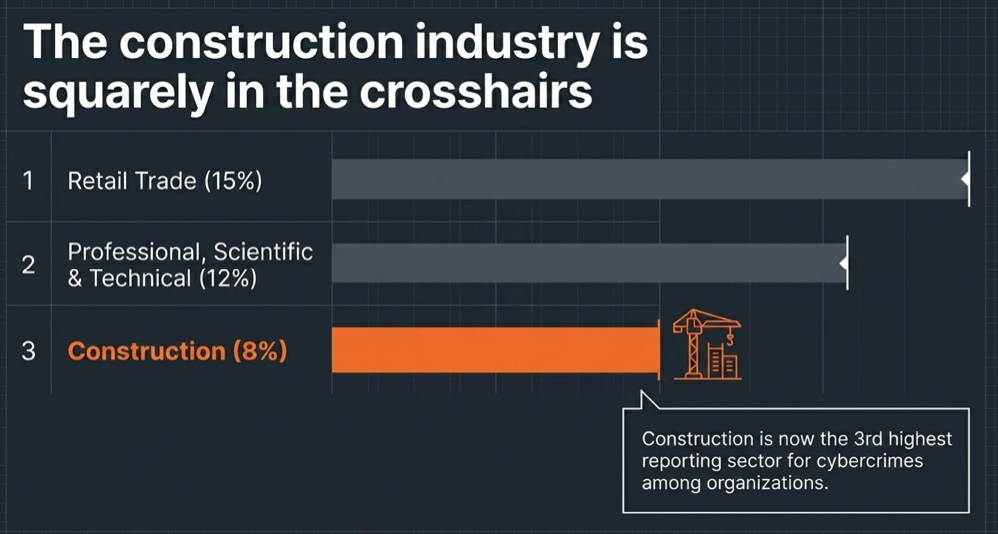
What Cybersecurity in a Construction Company Usually Covers?
Cybersecurity in a construction company usually covers the systems and routines that keep work moving without opening unnecessary risk:
- User access for staff, consultants, subcontractors, and vendors
- Email and payment approval controls
- Sharing permissions for drawings, RFIs, models, and contract files
- Mobiles, laptops, tablets, and other site-connected devices
- Backups and recovery for live project data
- Setup and monitoring for cameras, sensors, and other connected site technology
Why does the issue spread beyond IT? Cybersecurity in construction company settings is often treated as a background IT issue until it disrupts a live project step.
The IT problem in the construction industry is that the weak point is usually the handover between the device, the person, the approval path, and the file environment.
When progress claims, consultant updates, subcontractor onboarding, and site instructions all depend on shared systems, the risk becomes operational very quickly. That is why cybersecurity in construction is better understood as part of project control
Why Cybersecurity Risk is Growing in Construction Industry?
The cybersecurity risk in the construction industry is growing because of a rapid shift to digital tools. Tablets, BIM platforms, and shared folders speed up collaboration but also expand the number of potential entry points for attackers.
Let’s break down several key reasons why cybersecurity risk is growing in the construction industry:
- ASD’s ACSC reported more than 42,500 hotline calls and over 1,200 cyber security incidents in FY2024-25, which shows that attacks are not isolated events but part of a steady operating backdrop.
- ASD’s 2023-24 reporting shows average self-reported cybercrime costs of $49,600 for small business and $62,800 for medium business, with nearly $84 million in total losses linked to business email compromise.
- BIM systems, project clouds, and shared folders have become core to how construction teams coordinate work, but they also expand the number of entry points attackers can use.
- Construction firms still rely heavily on email for supplier communication and payment approvals, which makes business email compromise a direct financial risk.
- Rotating subcontractors and consultants increase the number of users accessing project systems, often with varying levels of security practice.
- Passwords are still shared across teams, stored in unsecured ways, or reused across platforms, particularly when speed is prioritised over control.
- Cameras, sensors, tablets, and other connected devices are often deployed quickly on site, sometimes without full configuration or ongoing updates.
- Technology adoption in construction has accelerated faster than updates to governance, access control, and security procedures.
Common Cybersecurity Risks in Construction
During our work as an IT services for construction industry, we saw that cybersecurity risks in construction often emerge from daily routines and overlooked details.
Many Australian firms face unique pressures, including compliance with local standards and the complexity of subcontractor-heavy projects.
Below are five risks that project teams across Australia need to recognise early:
- Ransomware attacks: This is rising sharply in Australia’s construction sector, with mid-sized contractors often hit the hardest. The Australian Cyber Security Centre (ACSC) recorded a 23% increase in incidents during 2023, many linked to poor backup routines and outdated systems.
- Data breaches: The data breaches increasingly common because project information sits across mobile devices, cloud storage, and local servers. Sensitive files such as client contracts, architectural plans, and site credentials are exposed when configurations are weak.
- Supply Chain Attacks: Australian construction supply chains are vulnerable due to inconsistent cybersecurity maturity among smaller trades and service providers. A single compromised account can grant attackers indirect access to the main contractor’s systems.
- Phishing and social engineering: The ACSC notes that construction firms are prime targets due to their frequent use of email-based approvals and invoice workflows. Attackers impersonate trusted contacts to redirect payments or harvest credentials through urgent-looking emails.
- IoT device vulnerabilities: Many IoT devices are deployed without firmware updates or network segmentation, leaving them open to intrusion. Site sensors, smart cameras, and connected machinery introduce new attack surfaces.
The Business Impact of Cyber Attacks in Construction
The business impact of cyber attacks in construction is rarely limited to IT teams. Disruptions flow quickly into site operations, financial management, and contractual obligations. For Australian firms working under strict compliance and delivery frameworks, the impacts below directly decide whether a project stays profitable or slips into loss:
- Project delays: Locked drawings or inaccessible schedules cause stoppages on site. This will push back pours, inspections, and handovers.
- Liquidated damages (LDs): Missed milestones under contract expose contractors to financial penalties.
- Cost overruns: Recovery work, external consultants, and overtime inflate budgets under pressure.
- Reputation damage: Data breaches reduce client confidence and can affect future tender opportunities.
- Compliance penalties: Breaches of the Australian Privacy Act or ISO 19650 obligations trigger regulatory scrutiny.
- Cash flow disruption: Phishing or invoice spoofing diverts payments and forces finance teams into manual checks.
- Supply chain impact: Compromised subcontractors delay critical inputs like design updates or prefabricated components.
- Operational downtime: Systems taken offline for containment limit communication between field teams and the office.
- Insurance complications: Firms without adequate controls face higher premiums or rejected cyber insurance claims.
Cybersecurity Best Practices for Construction Firms
Multi-layered Security
Layering email filtering, endpoint protection, and identity safeguards is a good approach. Each layer can catch things others might miss during a busy day. Visibility improves when alerts are tied to specific roles and workflows. Keep access separate for the office, site, and vendors.
Yes, we typically suggest clients segment network access so site visitors use a separate Wi-Fi from project data. This limits how far an issue can spread if one device is compromised. We also recommend keeping a network diagram updated for quick reference during incidents.
Strong Access Controls
Use multi-factor authentication and conditional access for staff and vendors. Review and change access as crews shift and projects wrap up. Make sure privileged actions are temporary and logged for review. Use approval flows for sensitive changes.
Map out who can see drawings, contracts, and financial data. Always verify identities before you release any payment details. Even simple approval flows help ensure drawings and costs only move through the right hands.
Employee Training
Always run brief and frequent phishing drills that feel like real project scenarios. Share examples from recent attempts and point out the telltale signs. The main idea of these approaches is to help your staff:
- Build awareness
- Recognise signs before they cause disruption
- Reporting becomes second nature
Then, please reward quick reporting so people are encouraged to act early. When possible, include subcontractors in awareness sessions. Provide a simple playbook for suspicious emails and links.
Cloud and Network Security
Enable the built-in protections in platforms like ACC, Procore, and related tools. Standardise sharing settings and expiry rules for external collaborators. Check logs for unusual download spikes from time to time.
Segment Wi-Fi for guests, site devices, and corporate access. Monitor internal network traffic so lateral movement is visible. Record changes and keep your network diagrams current.
Regular Patch Management and Software Updates
Schedule software updates for quiet periods, like early Tuesday mornings. Focus on critical systems that handle payments or project data. Track any delayed updates with a clear reason and resolution date.
Use automated tools where possible to apply patches consistently. Report update status in regular project reviews alongside schedule updates. This keeps security part of standard operational discussions.
Data Backup and Disaster Recovery
Keep regular backups of project data in a separate location from live systems. Test restoring files quarterly to ensure the process works. Record the steps so anyone can follow them under pressure.
Protect backup accounts with strong passwords and multi-factor authentication. If digital tools are unavailable, practice working with paper-based systems. This preparation minimises downtime during an incident.
Third-party Risk Management
Add a security checklist to your subcontractor onboarding process. Require basic measures like multi-factor authentication for their accounts. Only grant access to data necessary for their specific work.
Review vendor permissions after project phases or scope changes. Remove accounts when subcontractors complete their work. Maintain a simple log of vendor security practices for reference.
Routine Controls
The strongest cybersecurity in construction industry practice usually comes from repeatable control points. One MFA rollout helps. One phishing reminder helps. One patching push helps.
The bigger gain comes when those checks are built into onboarding, mobilisation, consultant access review, project stage changes, and closeout.
For a construction company, that often decides whether a problem stays contained or spreads into drawing access, payment approvals, and live coordination.
This is also where a practical support model matters, because the real pressure usually lies in document control, shared access, vendor turnover, and site-to-office workflow handoffs.
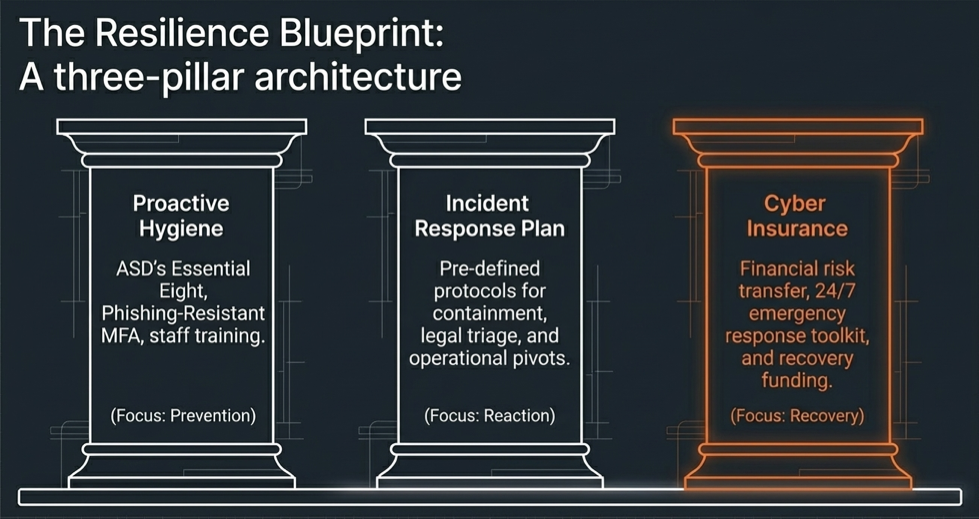
Back Up Your Security Strategy with Cyber Insurance
Cyber insurance for construction is best treated as backup for financial fallout. It may help with incident response, recovery costs, business interruption, legal expenses, and some liability exposure.
What it does not do is stop a compromised approval chain, restore weak access discipline, or fix poor recovery preparation on its own. That matters because in construction, the pressure lands in live operations first:
- Issued drawings become inaccessible during coordination
- Payment verification shifts to manual checking under time pressure
- Shared project platforms are locked down during investigation
In most cases, disruption starts before any policy wording becomes useful.
Now, what to check before relying on cover? Cyber insurance for construction becomes more useful when the policy reflects how the company actually delivers projects:
- Whether business interruption wording fits reliance on shared project platforms, document environments, and cloud-based coordination
- Whether invoice fraud, payment redirection, privacy exposure, and third-party access pathways are addressed clearly
- Whether the insurer expects controls such as MFA, endpoint protection, tested backups, and incident response preparation before claims are handled without extra friction.
This is where the difference usually starts to show in day-to-day operations. For reference, here several case study of cyber insurance for construction:
- A Sydney fit-out contractor working on tight supplier timing may care more about payment fraud response and operational interruption than headline coverage limits.
- A 30-person design practice coordinating through shared drawing and model environments may need to look harder at third-party access conditions, notification duties, and recovery support.
- A builder with rotating subcontractor access across several active jobs may need to check whether policy assumptions match how accounts are issued, reviewed, and removed over time.
But even with the right policy, the outcome still depends on what sits underneath. Cyber insurance becomes more practical when it sits on top of working controls.
That means, we talked about clear access management, tested backups, cleaner approval paths, and a basic incident response process do most of the heavy lifting.
The policy then supports recovery, rather than trying to compensate for gaps that should have been controlled earlier.
Should You Use Managed Security Solutions?
Managed security solutions help construction firms keep security controls running consistently across projects, without adding extra load to internal teams.
In many cases, the issue is not a lack of tools, but gaps in day-to-day execution as projects move and teams change.
In construction environments, those gaps tend to show up during onboarding, handovers, and access changes. Accounts stay active longer than needed, permissions drift, and alerts go unchecked.
Over time, these small issues can build into real operational risk.
A managed cybersecurity approach can be useful when:
- Internal IT is already stretched across support and project demands
- Multiple projects run in parallel with different access needs
- Subcontractors and consultants frequently rotate in and out
- Security tools are in place but not regularly reviewed or maintained
- There is no clear process for monitoring or responding to incidents
Most managed services focus on keeping existing systems working as intended.
This includes monitoring login activity, reviewing access rights, applying updates, and following up on unusual behaviour before it affects operations.
For construction firms, consistency is where the value lies. Access is reviewed as projects progress, updates are applied on schedule, and potential issues are picked up earlier.
This helps reduce the chance of disruptions that affect drawings, approvals, or site coordination.
Internal processes still matter. Teams need clear approval paths, controlled file sharing, and basic awareness of common risks.
Managed security supports those routines by reducing blind spots and keeping controls active in the background.
In practice, many companies use managed security to bring stability across projects while improving their overall security posture over time.
How Interscale Protects Construction from Cyber Attacks?
Our cybersecurity specialist at Interscale will typically begin with a concise assessment that mirrors your project structure. We align controls with your current platforms and subcontractor access. We believe every construction project has its own structure, and security needs to reflect that.
Once the foundation is clear, controls are aligned with delivery schedules and available resources. Monitoring, staff training, and regular reviews are provided in ways that teams can maintain without disruption. Plus, reporting is integrated into leadership routines so progress and risks remain visible at the right level.
Our cybersecurity services in Australia are built for construction environments that demand speed and compliance. We provide practical measures that fit into daily operations while strengthening resilience against cyber threats. With Interscale, our clients gain reliable protection that supports projects from tender to handover.
Talk to our expert for a free initial consultation and plan your cybersecurity strategy with confidence.
FAQ
Why is Cybersecurity Important in Construction?
What are the Top Cyber Risks of Construction?
What is Cybersecurity Risk Management in Construction?
References
- Australian Signals Directorate. “Annual Cyber Threat Report 2024–2025.”
- Australian Signals Directorate. “2023–24 Cyber Threat Trends for Businesses and Organisations.”
- Australian Signals Directorate. “Annual Cyber Threat Report 2023–2024.”