

A guide to BIM implementation matters when an Australian AEC firm needs the model, drawing issue, and approval path to stay aligned once delivery pressure increases.
That pressure usually appears when architects, engineers, consultants, project managers, and commercial reviewers all rely on the same information at different stages, but publish timing no longer matches approval timing.
That alignment issue is only the visible part. The harder question is whether the business can rely on the information it is issuing, pricing from, reviewing, and handing over once several teams touch the same record. And that’s what we’re gonna break down in this guide.
What is BIM Implementation?
BIM implementation is the structured setup of people, information rules, software, and approval controls so project information can move through design, coordination, issue, and handover without losing reliability.
NATSPEC states that the AS ISO 19650 series can improve BIM implementation in Australia and New Zealand by providing a common framework across organisations and projects.
So, implementation is not the same as buying software. Implementation is the point where naming rules, revision states, exchange requirements, and decision rights are made operational.
If that step is skipped, teams can invest in tools while approval and information control remain unresolved. Once that happens, the software may be active, but the business still cannot tell with confidence what can be relied on.
That is why older discussion around BIM level becomes less useful than a simpler set of questions:
- What information is required?
- Who can rely on it?
- What status does it carry?
- Which environment holds the current record?
Those questions lead directly to the real failure point, which is usually not modelling effort on its own but uncertainty around status, approval, and which record can actually be relied on.
Why BIM Implementation Fails in AEC Firms?
BIM implementation fails in AEC firms when software access is solved before information authority is solved. The first thing that usually breaks is status confidence.
For example, in a 30-person practice, the architecture model may be current in Revit while the consultant mark-up sits in email and the commercial response sits in Teams. Once that happens, the project lead is no longer checking only whether the model is complete.
They are checking whether consultant instructions were incorporated before issue, whether the drawing package matches the latest model decision, and whether the set can be priced from without qualification. The checking effort shifts from model quality to record reconstruction.
That pattern is not unusual in Australia. Deloitte’s State of Digital Adoption in the Construction Industry 2025 says the average Asia Pacific construction business now uses 6.2 technologies, up 20% from 5.3 the year before.
That’s why mixed environments are normal, which means coordination failure often comes from fragmented handoffs rather than weak modelling alone. Once that is clear, the next question is how to implement BIM in your project without reproducing the same fragmentation inside a more expensive toolset?
Step-by-step to Implement BIM in a Project
Define Business Objectives
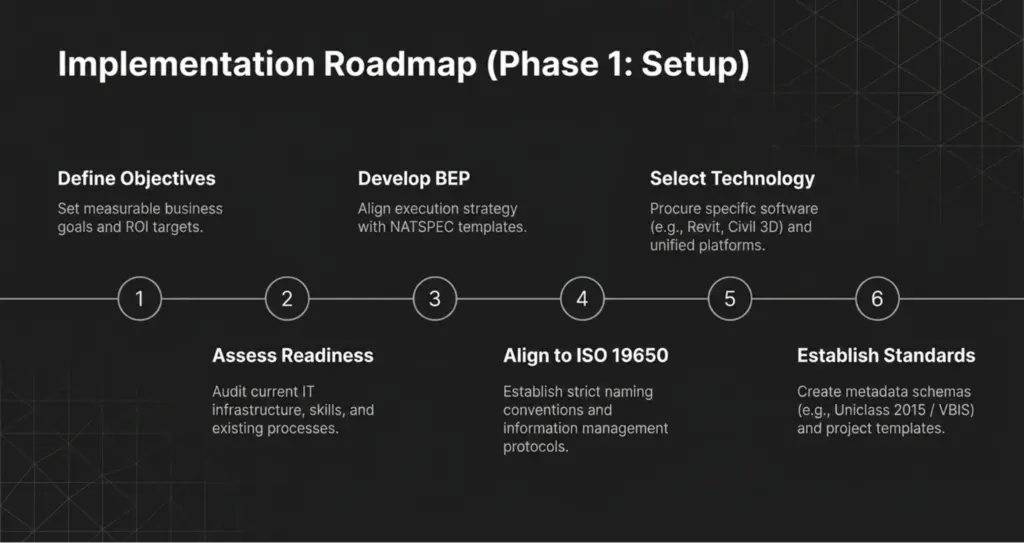
Business objectives should state what the business needs to control better. Because A BIM implementation strategy is stronger when the target is operational and clear. That may be fewer late coordination changes, cleaner consultant exchanges, or more reliable issue status before tender or site release.
If the objective is too broad, the first thing that usually fails is procurement logic. The business buys software before it defines what the software is meant to reduce, protect, or make more reliable. The next check is whether the current business is ready to support that objective in live delivery.
Assess BIM Readiness
BIM readiness matters because weak rollout usually starts before software goes live. The issue is whether skills, templates, approval behaviour, consultant interoperability, and current software fit can support one controlled publish logic once delivery starts moving.
In an Australian SME, that also means asking whether a director, project lead, document controller, and BIM lead are all relying on the same status rules.
If they are not, the model may be technically correct while the release path is already unstable. A drawing can be ready for issue in one team’s view and still be under review in another. That is where rechecking starts to replace trust.
Develop a BIM Execution Plan (BEP)
A BEP matters because exchange points fail quickly when nobody has defined what is being issued, when it is being issued, and who can rely on it. Once those points stay informal, teams fill the gaps with local habits, inbox decisions, and verbal confirmation.
That is why a BEP belongs early. BEP defines what information is produced, when it is exchanged, what status it carries, and who can rely on it. NATSPEC places BEP resources alongside project information requirements and implementation templates in its National BIM Guide material.
Align with ISO 19650 Standards
In the BIM process, ISO 19650 alignment gives the team a shared structure for naming, information states, review, and exchange. What breaks first without that structure is usually not the model file. It is the ability to tell whether a file is shared, published, superseded, or still under review.
NATSPEC’s guidance links ISO 19650 to information requirements, Common Data Environments, roles, responsibilities, legal, and security considerations.
That is why alignment matters commercially as well as technically. It reduces ambiguity around what can be relied on and when. Once that structure is defined, software choice becomes easier to judge against actual workflow needs.
Select the Right BIM Software and Technology
Software choice should follow modelling depth, coordination load, and exchange complexity. Once Autodesk tools such as Revit or BIM Collaborate Pro are chosen, a structured Autodesk tool implementation turns that choice into reliable delivery. This table below break down several popular BIM software and technology in Australia:
| Software / stack | Best fit | Main role in BIM process | Workflow position | Data exchange / interoperability |
| Revit | Multidisciplinary building teams | Parametric BIM authoring (architecture, structure, MEP) | Core design + documentation | Native RVT ecosystem; IFC export/import supported but often controlled |
| Archicad | Architecture-led firms, Mac environments | Architectural BIM authoring with OpenBIM focus | Design + documentation | Strong IFC/OpenBIM workflows; better cross-platform exchange |
| Tekla Structures | Structural engineers, fabricators | Fabrication-level structural modelling | Detailed design + construction | High-detail model exchange; IFC and fabrication data integration |
| Navisworks | Contractors, coordination teams | Model aggregation, clash detection, 4D simulation | Coordination + pre-construction | Aggregates multiple formats (RVT, IFC, DWG); read-heavy coordination tool |
| BIM Collaborate Pro | Distributed teams needing cloud workflows | Cloud model sharing and coordination | Coordination + review environment | Cloud-based sharing within Autodesk ecosystem; limited outside control without IFC |
| Bentley OpenBuildings | Infrastructure-heavy or complex projects | Multidisciplinary BIM for large-scale assets | Design + infrastructure integration | Strong IFC and infrastructure data exchange within Bentley ecosystem |
| Vectorworks Architect | Design-focused firms, Mac users | BIM authoring with strong visualisation workflow | Early design + documentation | IFC-based interoperability; less dominant in mixed consultant stacks |
Establish Standards and Templates
Establishing standards and templates matters because they determine whether model outputs stay consistent across projects and teams.
Standards and templates should cover sheet logic, naming, view control, exports, issue states, and coordination rules. What breaks first without them is repeatability.
Teams start solving the same drafting and exchange problem differently from project to project. Once that happens, model checking takes longer, staff transfer becomes harder, and coordination cost rises because each project carries its own local logic.
That is why standards are not a cleanup task after rollout. They are what let the software decision behave consistently enough to be trusted.
Build Internal Capability
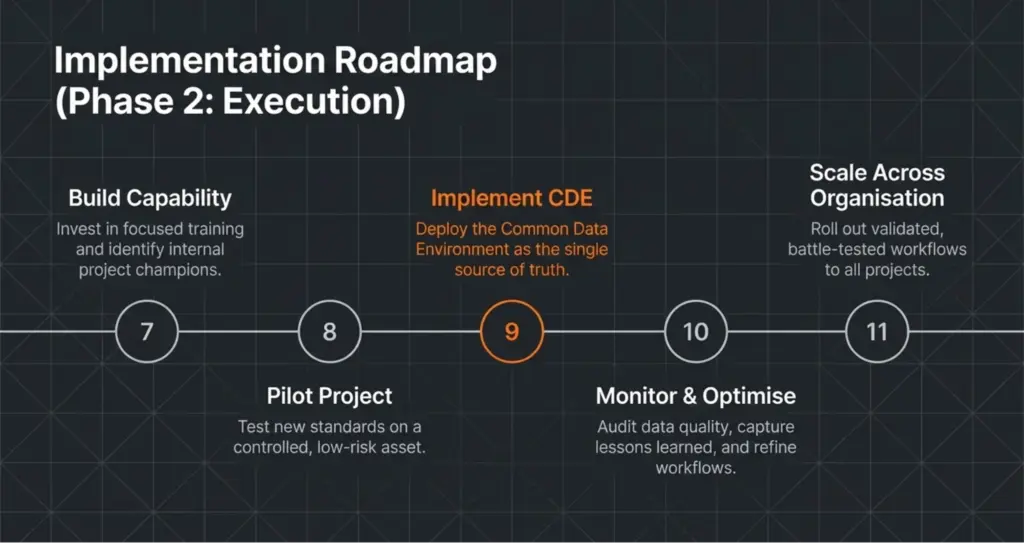
Internal team capability should be built based on role-based so model outputs, coordination decisions, and issue ownership stay reliable under delivery pressure. For example, BIM modellers need authoring discipline, while coordinators need federation and issue ownership.
Project leads need enough technical understanding to know when a BIM model is reliable enough to price from, issue from, or send to consultants without creating downstream rechecking.
The risk here is not lack of training in the abstract. It is decision-making without enough confidence in what the model status actually means. Once capability gaps sit inside live approvals, issue confidence and pricing confidence start to weaken.
That is when the workflow needs to be tested under real pressure without forcing every team into the same change at once.
Start with a Pilot Project
Your pilot project should be live enough to expose failure points, but contained enough that one project does not absorb office-wide disruption. If the trigger is a specific platform upgrade such as Revit 2027, our Revit 2027 expectations guide flags the version-specific risks worth testing first.
If you are managing a medium-size fitout or education project, a pilot is useful when it tests consultant timing, internal approvals, and CDE discipline under real delivery conditions.
That matters because a pilot is not just there to prove the model can be built. It is there to prove that exchange, review, and issue control still hold up once people are busy. Once that test begins, the environment carrying the record becomes the next point of pressure.
Implement a Common Data Environment (CDE)
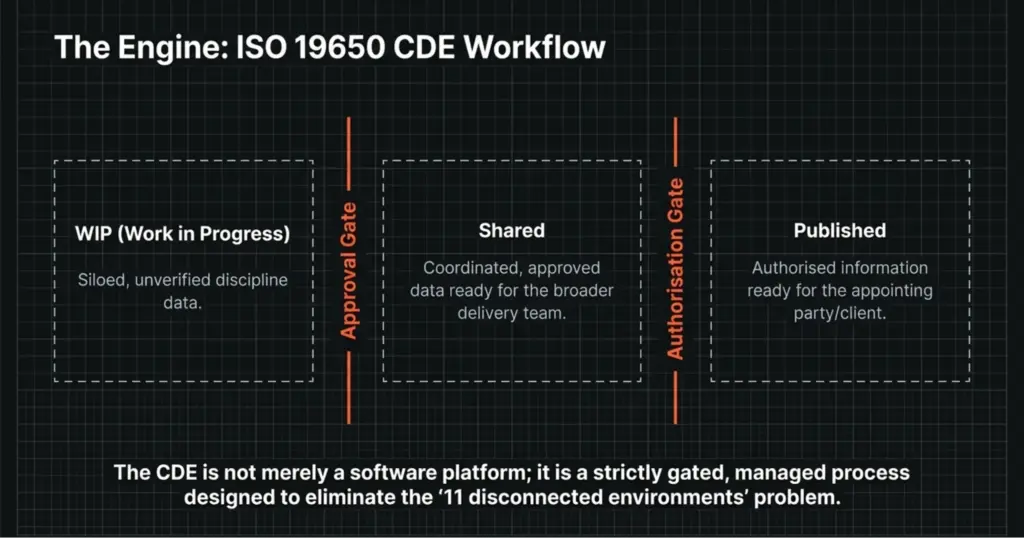
Implementing CDE matters because traceability usually fails before file exchange fails. Teams may still send information, but they lose certainty around version, status, review history, and who approved what.
A Common Data Environment is the controlled environment for collecting, managing, and distributing project information. Autodesk University’s ISO 19650 material ties the common data environment directly to standards-based information management in construction delivery.
Once traceability weakens, approvals become harder to defend and handover becomes harder to verify.
Monitor and Optimise Performance
Monitoring and optimisation matter because performance data only becomes useful when it leads to adjustments in coordination, issue handling, and release timing.
Performance should be monitored through publish delays, duplicated issues, time lost to status clarification, handover-data gaps. Seat usage and model file count are weak indicators.
The question is whether your BIM implementation reduces rechecking effort. If publish dates are still slipping, if teams still ask which package is current, or if handover data still needs manual cleanup, the workflow has not settled yet.
Once those measures start to stabilise, the business can decide whether the method is ready to move beyond one project or one team.
Scale Across the Organisation
Scaling should be applied once standards, BEP logic, and approval behaviour are stable so the organisation expands one consistent workflow instead of multiple local variations. In a 50-person firm, scaling too early usually creates local BIM habits under one subscription stack.
That increases variation instead of reducing it. The result is several project-level standards hiding inside one licence environment. So, the firm then has to decide how broadly implementation should spread and what rollout structure best matches its risk.
Types of BIM Implementation Plan
Different implementation plans solve different failure points first, as you can see in table below:
| Plan type | Best for | Strength | Main risk | What breaks first |
| Project-led | Firms testing BIM on one active project | Fast delivery-based learning under real conditions | Office standards remain uneven | Model status and naming logic vary between projects, increasing rechecking effort |
| Discipline-led | Architecture, structure, or services teams fixing one workflow | Clear ownership within one modelling or coordination stream | Cross-discipline handovers stay weak | Exchange points between disciplines lose clarity, creating coordination lag |
| Organisation-led | Firms aligning standards, software, and approvals across teams | Better consistency and procurement control across the business | Slower initial rollout | Delivery slows early while teams adapt to new approval and publish controls |
Pro tip: The wrong choice usually shows up when the rollout succeeds in one area but fails to travel across teams. That is also where implementation cost starts to look different from licence cost.
Cost to Implement BIM
The cost to implement BIM sits in the software, the work needed to make information reliable across teams, approvals, and delivery stages. Here a guide to cost of BIM implementation:
Standards Work
BIM costs rise when a firm has to standardise naming, revision control, metadata, and classification rules across projects. ISO 19650 alignment, Uniclass 2015, and systems such as VBIS do not add value by sitting on paper. They add cost first because teams have to build and enforce them.
BEP and Coordination Setup
Cost appears early because a BIM Execution Plan must be defined before delivery starts. Teams have to define who delivers what, when information is exchanged, what status it carries, and who can rely on it. That planning effort is necessary, but it is still costly.
CDE Workflow Redesign
Cost increases when firms have to rebuild workflows around a Common Data Environment. A Common Data Environment is a platform and a controlled process.
Firms have to rebuild folder logic, approval paths, permissions, issue handling, and publish states so the record holds together under pressure. That is usually where implementation effort becomes heavier than expected.
Change Overhead
Cost increases when BIM changes how teams work, not just what software they open. That creates training cost, internal resistance, capability gaps, and the need for clearer information ownership. Some firms also need dedicated information management support to keep the system working in practice.
Hidden Rechecking Labour
The highest cost is often manual verification while old and new workflows overlap. When teams still double-check models, issue sets, and approvals by hand, BIM has not reduced effort yet. It has simply moved the effort into a different part of delivery.
Common BIM Implementation Challenges in Australia
The common challenges below show where the breakdown of BIM usually starts:
- Client requirements vary across projects, so teams reset information standards, deliverables, and expectations each time instead of carrying one consistent workflow.
- Public-sector mandates, such as Queensland Government projects above A$50 million requiring BIM from early planning, introduce stricter controls that do not always align with private-sector delivery pace.
- Consultant capability differs by discipline and region, so model exchange quality, timing, and reliability shift across the same project.
- Coordination timing drifts when teams publish at different speeds, creating gaps between model updates, issue tracking, and drawing release.
- Approval decisions often sit in Microsoft 365, email, or PDF markups, which separates the decision record from the model record.
- Mixed software stacks across firms increase friction at handover points, especially when authoring, coordination, and review tools do not align.
- Procurement may centralise software decisions while project teams interpret BIM requirements differently, creating variation under one licence environment.
- Model status becomes unclear when teams cannot consistently confirm whether information is work in progress, shared, or approved for issue.
- Rechecking effort increases as teams spend more time verifying information across systems instead of relying on a single controlled record.
- Successfully transitioning to BIM requires a workforce equipped to use complex digital tools and manage data effectively over an asset’s lifecycle.
Should You Use BIM Implementation Services?
You should use BIM implementation services when BIM starts affecting delivery control. At that point, the issue is whether those models can be trusted across coordination, approval, and issue. That shift shows up through repeatable signals in day-to-day delivery:
- Your teams spend more time checking information than using it
- The model status cannot be confirmed without cross-checking
- Approvals sit in email or Teams instead of the project record
- Coordination effort increases as more teams and projects are added
- One pilot workflow cannot scale across the organisation
That’s why structured BIM implementation services from Interscale can help you. The value of Interscale is in sequencing standards, BEP, CDE, and workflows, so your system holds under delivery pressure, rather than correcting gaps after rollout.
Because if BIM is already in implementation but delivery still feels inconsistent, the problem is how the workflow is structured and controlled, which is why you need external guidance.
FAQ
How Long Does BIM Implementation Take?
Do Australian Projects Really Require BIM?
What are the Main Challenges in BIM Implementation
What Software is Used for BIM Implementation?
Source Basis:
- NATSPEC. AS ISO 19650 BIM Information Management Framework. Australian adoption of ISO 19650 standards for BIM processes and information governance. accessed April 2026. https://bim.natspec.org/resources/bim-topics/40-as-iso-19650
- NATSPEC. BIM Execution Plan (BEP Templates. Practical BEP structure for planning information delivery and coordination responsibilities. accessed April 2026. https://bim.natspec.org/documents/natspec-bim-execution-plan-bep-templates
- Autodesk University. ISO 19650 and Common Data Environment (CDE Explained. Definition and operational role of CDE in BIM information control. accessed April 2026. https://www.autodesk.com/autodesk-university/article/ISO-19650-Common-Data-Environment-and-Autodesk-Construction-Cloud
- Deloitte Australia. State of Digital Adoption in Construction Industry 2025. Data on technology adoption levels and multi-system environments in construction. accessed April 2026. https://www.deloitte.com/au/en/services/economics/analysis/state-digital-adoption-construction-industry.html
- Queensland Government. BIM Projects Data and Information Guideline (QGEA. Public sector guidance on BIM and digital engineering practices in Australia. accessed April 2026. https://www.forgov.qld.gov.au/information-technology/queensland-government-enterprise-architecture-qgea/qgea-directions-and-guidance/qgea-policies-standards-and-guidelines/bim-projects-data-and-information-guideline
- UK BIM Framework / IMI. ISO 19650 Transition Guidance FAQ. Clarification on BIM maturity levels and implementation approach aligned to ISO 19650. accessed April 2026. https://imiframework.org/faq/