 Skip to content


Capital efficiency is often the defining metric for sustainable growth in the modern market. We observe that the landscape of equipment finance has matured significantly across Australia small to medium business to support this need for agility. And yes, the trend today is that leaders prioritise access to capability over the heavy burden of ownership.
SImply put, buying depreciating assets with cash is rarely the most strategic use of your reserves. You effectively lock your liquidity into hardware that loses value the moment it is unboxed. Financing offers a mechanism to match your costs directly to the revenue those assets generate.
In this article, we will break down what IT equipment finance for small businesses really is.
How Equipment Financing Works?
The fundamental concept of equipment finance involves a lender purchasing the asset while you pay for its utility over time. This structure shifts the burden of upfront payment away from your immediate cash flow.
However, always remember that when assessing a business equipment loan, you must look beyond the monthly repayment to the interest rates involved.
Contracts vary significantly based on whether you intend to return the hardware or own it eventually. Operating leases generally act as rental agreements where the technology is returned after the term. Finance leases typically offer a path to ownership through a residual value payment.
Lenders in this space focus on the inherent value of the hardware rather than just your balance sheet. This distinction often makes approval faster than traditional banking channels. It allows younger entities to secure enterprise-grade tools based on their operational potential.
Key Advantages of Equipment Financing for Small Businesses
Here’s what our clients across Australia gain when they stop buying equipment outright and start financing it with intention:
- You preserve cash for growth decisions instead of locking it into hardware.
- Predictable repayments prevent budget shocks and smooth out financial planning.
- Refresh cycles stay on schedule, reducing risk during high-demand seasons.
- Teams stay productive because their tools consistently match real workload demands.
- Costs follow a clear pattern that managers can fit into annual plans.
- Upgrade timelines become easier to communicate across finance, IT, and leadership.
- Governance improves because directors see structured, forward-looking lifecycle decisions.
When Equipment Financing Makes the Most Sense?
These are the moments when equipment financing becomes a strategic action for small businesses:
- Your industry upgrades rapidly, and outdated tools weaken your competitive position.
- You rely on an MSP to manage your whole IT lifecycle with discipline.
- You want to protect bank facilities for true expansion, investment, or acquisitions.
- Your revenue is project-based, and expenses must align with contract timing.
- You need to scale infrastructure instantly to meet a new client’s requirements.
- You prefer assets that effectively pay for themselves during their usable life.
- You need a rapid deployment that traditional bank loan processes cannot match.
- You want your teams equipped while competitors are still waiting for approvals.
Types of Equipment that Can be Financed
Various types of equipment can be financed when small businesses need predictable costs and steady refresh cycles. Therefore, these categories below represent several items that benefit most from steady refresh cycles and predictable costs:
- You can use computer and laptop financing to keep core workstations reliable.
- High-performance workstations are financed because their usable peak performance declines faster.
- Monitors and docking stations are financed since they support everyday productivity.
- Switches, firewalls, and Wi-Fi systems are often managed through IT equipment leasing to keep upgrades consistent.
- Servers and storage units are financed to match their planned hardware lifespan.
- Tablets and mobile devices suit financing when teams operate across multiple locations.
Equipment Financing vs Other Lending Options
While equipment finance focuses on funding new assets, other solutions such as debt consolidation lending options are designed to restructure existing obligations. The right choice depends on whether your priority is improving cash flow from current liabilities or enabling new operational capability.
How Small Businesses Can Get Started
The first step is conducting a thorough audit of your technological requirements vs. your cash position. We suggest using a robust calculator to model how equipment financing impacts your small business P&L before committing. The financial modeling ensures the repayments remain sustainable even during slower trading months.
For reference, here is Interscale calculator which you can access in our website:
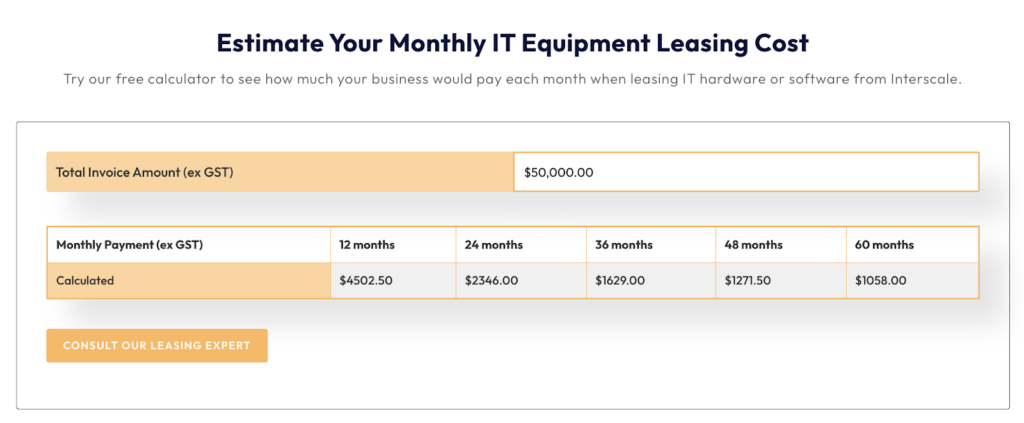
Then, time to choose the right partner, which is as critical as choosing the right hardware. Specialised provider, like Interscale, understand that IT assets depreciate faster than industrial machinery. Therefore, our structure terms align perfectly with the hardware’s functional lifespan.
Reach out to Interscale to analyse which funding structure aligns with your strategic goals. We can help clarify the documentation requirements to expedite your approval process. We believe a brief consultation can prevent you from locking yourself into inflexible or expensive terms.
What This Means for Your Business
Strategic funding transforms technology from a cost center into a manageable utility. It protects your liquidity while ensuring your team has the tools to compete. This approach remains the gold standard for agile business management.


