

A BIM management plan becomes important in Australia AEC projects when model information is needed to support design decisions, coordination meetings, procurement, construction planning, and handover.
On many AEC projects, the risk does not appear because teams lack modelling capability. It appears when responsibilities, exchange rules, approval states, and handover expectations are not clear enough for a multi-party delivery environment. A good plan gives those moving parts a common structure.
This article explains what a BIM management plan needs to include, when it becomes necessary on Australian projects, and how project teams can build one without turning it into a document nobody uses.
What is a BIM Management Plan and How It Differs from a BIM Execution Plan?
A BIM management is a project document that defines how BIM information will be governed across a project, while a BIM execution plan explains how the appointed team will deliver the agreed BIM work.
The two terms often overlap in Australian project conversations. Some teams use the BIM Management Plan as the main control document. Others use BIM Execution Plan because ISO 19650 language appears in tenders, contracts, and digital engineering requirements.
The table below shows us how a BIM management plan sets the information rules, while a BIM execution plan explains how the team will follow them.
| Document | What it controls | Where it fits in the project | Practical question it answers |
| BIM Management Plan | BIM governance, information management rules, responsibilities, model standards, CDE workflows, approval states, and handover controls | Project setup, tender response, delivery governance, and ongoing BIM management | How will BIM information be managed, checked, approved, and maintained? |
| BIM Execution Plan | BIM uses, model production methods, coordination routines, software workflows, model exchanges, and delivery responsibilities | Usually prepared by the appointed delivery team after client or project requirements are understood | How will the team deliver the agreed BIM requirements in practice? |
| Exchange Information Requirements | Required information, exchange formats, delivery timing, acceptance criteria, and information purpose | Usually set by the appointing party, client, asset owner, or head contractor before delivery starts | What information must each party deliver, when, and to what standard? |
| Master Information Delivery Plan | Scheduled information deliverables, responsible parties, project milestones, and exchange dates | Built from task information delivery plans and used to manage information delivery across the project | Who delivers which information package, at which project milestone? |
When is a BIM Management Plan Required on Australian Projects?
A BIM management plan is required when an Australia project complexity, contract conditions, client expectations, or handover obligations make informal BIM coordination too risky. We believe a BIM management plan is usually worth formalising when:
- The client or tender asks for BIM, digital engineering, or ISO 19650 alignment
- Multiple consultants, contractors, or trades exchange models
- The project uses a Common Data Environment
- Model information supports tender, procurement, coordination, or staging decisions
- Asset information is required for handover
- Public-sector or infrastructure governance applies.
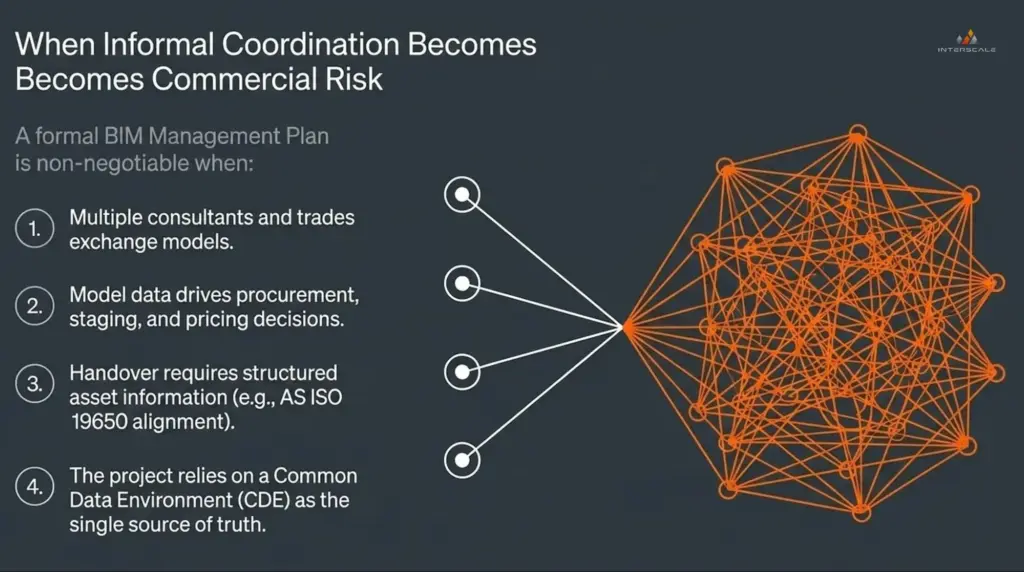
A BIM management plan becomes important when model exchange, procurement, handover, and CDE use start affecting project decisions.
The dilemma is that Australia does not have one national rule that makes every project use a BIM management plan. However, the requirement usually appears through:
- Tender documents
- Client information requirements
- ISO 19650 alignment
- Contractor standards
- Government digital engineering policies
- Internal delivery systems.
The need becomes clearer when looking at local delivery pressure. The Australian Bureau of Statistics reported that total construction work done reached $83.4 billion in the March quarter of 2026. Infrastructure Australia’s 2025 Infrastructure Market Capacity Report also reported a five-year Major Public Infrastructure Pipeline of $242 billion.
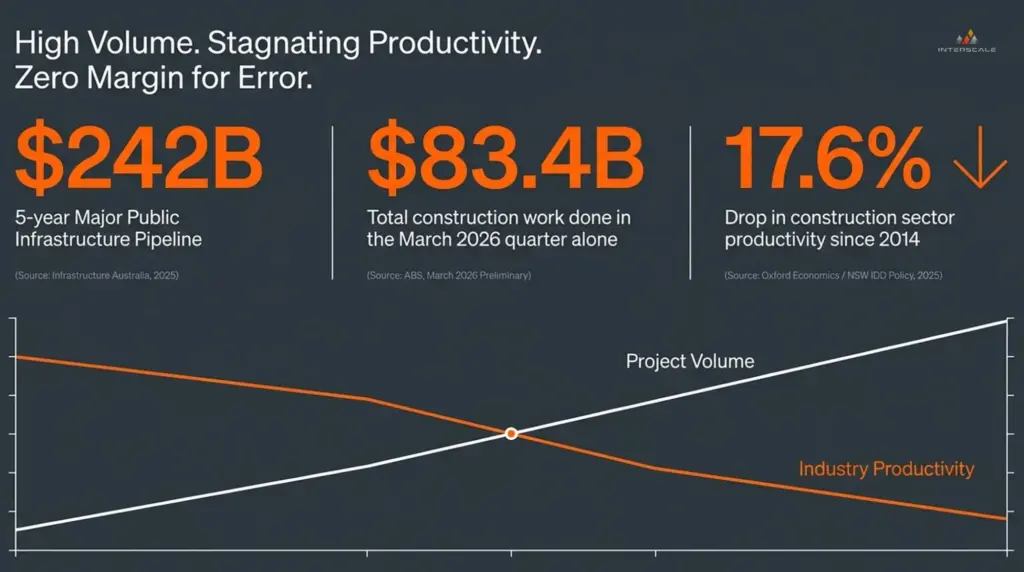
Australian construction volume is rising while productivity pressure leaves less room for unclear model information.
In that environment, coordination problems are harder to absorb after a model has already been used for design review, procurement, construction planning, or handover preparation.
Infrastructure NSW gives a clear example of where the Australian conversation is moving. Its NSW Infrastructure Digitalisation and Data Policy connects infrastructure digitalisation with documented information requirements, ISO 19650 alignment, CDE management, data standards, procurement, and asset lifecycle outcomes.
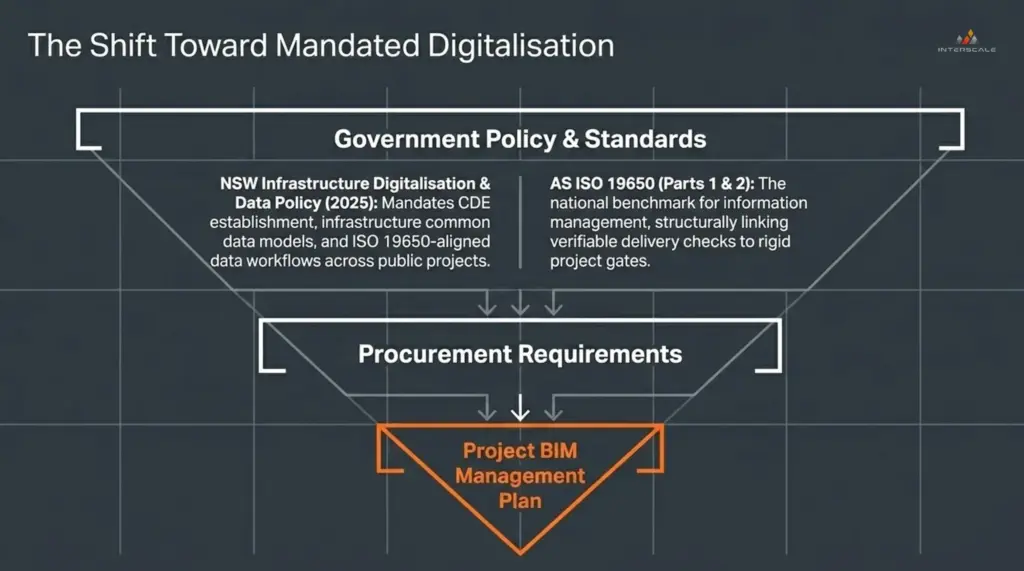
Public-sector digitalisation is pushing BIM management closer to procurement, information standards, and lifecycle asset data.
Key Components of a BIM Management Plan Aligned with AS ISO 19650
A BIM management plan aligned with AS ISO 19650 needs clear information requirements, accountable roles, agreed technical standards, and a controlled workflow for approval, coordination, and handover.
Together, these components show how project information will move from requirement to delivery, then from review to accepted use.
Information Management Framework and Project Information Requirements
The information management framework explains what information the project needs, why it is needed, when it must be delivered, and how it will be checked. The table below connects each requirement area with a delivery check.
| Requirement area | What the plan should define | What the team should check |
| Project Information Requirements | Why information is needed | Linked to approvals, tender, or handover? |
| Exchange Information Requirements | What each party must provide | Can each deliverable be checked? |
| Level of Information Need | Required geometry, data, and documentation | Is the detail useful at this stage? |
| Information delivery milestones | Timing of model, document, and data exchanges | Do milestones match project gates? |
| Acceptance criteria | How information will be reviewed | Who can accept or reject it? |
A stronger BIM management plan connects these requirements to real project decisions. It should explain what the contractor can price from, what the consultant can rely on, what the client can approve, and what the asset owner should receive at handover.
Roles, Responsibilities, and BIM Governance Structure
The governance section defines who creates, checks, approves, shares, updates, and accepts BIM information.
Without clear governance, naming rules, exports, issue tracking, model checking, and software decisions can quietly collect around one person. That creates a fragile BIM workflow.
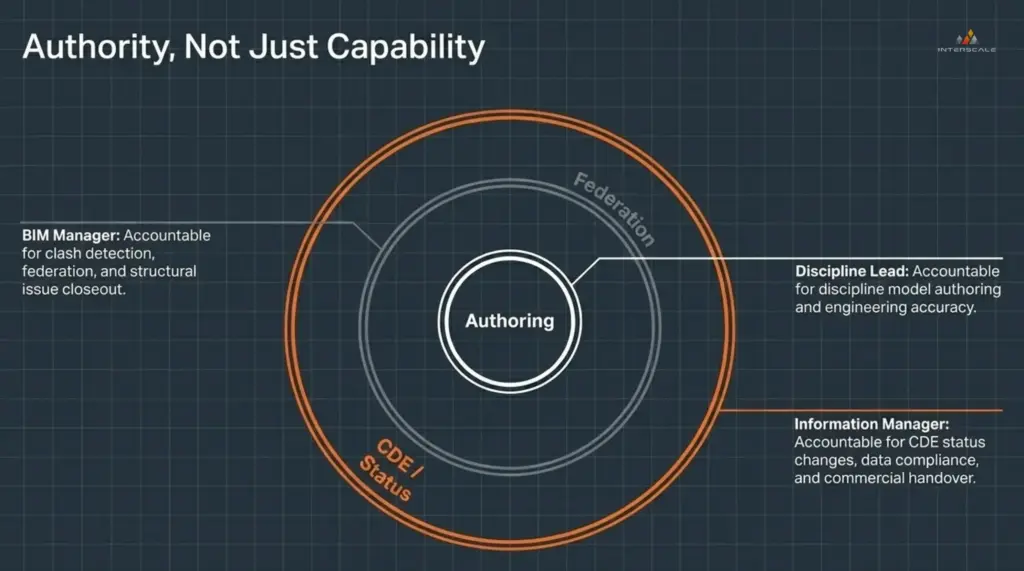
For example, a project may include information managers, BIM leads, discipline authors, document controllers, contractor coordinators, and asset information leads.
Each role needs a clear authority line, as you can see in the table, especially where model status, issue closeout, and CDE publishing affect project decisions.
| BIM activity | Responsible | Accountable |
| Discipline model authoring | Model author | Discipline lead |
| Model federation | BIM coordinator | BIM manager |
| Clash detection | BIM coordinator | BIM manager |
| CDE status change | Document controller | Information manager |
| Issue closeout | Discipline lead | BIM manager |
| Handover data review | Asset information lead | Appointing party |
BIM Standards, Protocols, and Technology Requirements
The BIM standards and technology section defines the technical rules that keep models reliable across authoring, coordination, exchange, and handover.
This section should cover software versions, templates, shared coordinates, naming rules, classification, parameters, export settings, issue tracking, and CDE permissions. These rules protect the model from becoming a collection of discipline files that only work inside each team’s own setup.
Shared coordinates need early attention. On contractor-led buildings, infrastructure interfaces, and mixed-use projects, coordinate drift can affect model federation, drawings, clash detection, site set-out, and subcontractor coordination.
The CDE workflow should also be clear. The plan should define where information lives, who can publish it, which status codes apply, how revisions are controlled, how approvals are recorded, and which formats are accepted for exchange.
This is where Australian public-sector direction gives useful context. Infrastructure NSW links ISO 19650-aligned requirements with procurement, data standards, CDE management, and infrastructure lifecycle outcomes.
Who Creates and Maintains the BIM Management Plan?
The BIM management plan is usually created by the client-side information manager, BIM manager, lead consultant, or lead appointed party, then maintained as project requirements change. The roles usually work like this:
- Client-side information manager: Defines the information requirements, approval expectations, CDE rules, and handover needs from the appointing party’s side.
- BIM manager: Turns those requirements into model standards, coordination routines, review workflows, and project-level BIM controls.
- Lead consultant: Prepares or coordinates the first version when BIM planning starts during early design or consultant-led delivery.
- Lead appointed party: Responds to the appointing party’s requirements and maintains the plan during delivery, especially on contractor-led or ISO 19650-aligned projects.
The plan should also define who can revise the document, how changes are approved, and how updates are communicated as the project team, scope, or asset data requirements change.
How to Develop a BIM Management Plan: A Step-by-Step Approach for Australian Firms
A BIM management plan should be developed by starting with project information needs, then turning those needs into roles, deliverables, standards, CDE workflows, review routines, and handover checks.
This order keeps the plan tied to project decisions. If the team starts with templates too early, the document may look complete before the delivery requirements are clear.
Confirm Why BIM is Needed
Start by identifying what BIM must support on the project before writing the management rules.
The answer may include design coordination, tender documentation, clash detection, quantity support, staging, asset data, facilities management, or client assurance. Each use changes the kind of information the plan needs to control.
A model used for design review may need clear discipline ownership, issue tracking, and review timing. A model used for handover may need structured asset data, agreed parameters, and acceptance checks. Defining the purpose early keeps the BIM management plan tied to real project decisions.
Review the Brief, Tender, Contract, and Client Requirements
Review the project brief, tender documents, contract clauses, Exchange Information Requirements, asset information requirements, and any digital engineering standards before writing the plan.
If the tender says BIM is required, ask what that means. The client may need coordinated models, IFC exchange, clash reports, structured asset data, or defined handover outputs.
Define BIM Uses and Deliverables
Define the BIM uses that directly support project decisions across design, coordination, procurement, construction, and handover. For your reference:
| BIM use | Example deliverable | Project check |
| Design authoring | Discipline models and drawings | Can the model support documentation? |
| Model coordination | Federated model and issue register | Are issues reviewed by the right parties? |
| Tender support | Model outputs and schedules | Can the information support pricing? |
| Construction planning | Staging model or sequencing review | Is the model detailed enough for the intended use? |
| Asset handover | Asset data and final model | Does the owner know what they will receive? |
This step keeps the plan practical. A BIM management plan should not list every possible model use because it sounds comprehensive.
Each use creates work for someone, whether that work involves model authoring, federation, clash reporting, quantity support, staging review, or asset data validation.
For that reason, each BIM use should be tied to a clear deliverable, owner, timing, format, and review expectation.
Build the Responsibility Matrix
Build the responsibility matrix so every major information activity has a clear owner, reviewer, and approval path.
The matrix should cover model production, model checking, federation, clash detection, issue closeout, CDE publishing, drawing issue, data validation, and handover review.
It should also show who has authority to approve information at each stage. That prevents model decisions from sitting with the nearest available BIM-capable person when the issue actually needs discipline, contractor, client, or asset-owner approval.
Set Modelling and Information Standards
Set modelling and information standards so each discipline produces information in a way the rest of the project team can use.
This step should cover the rules that affect coordination, documentation, exchange, and handover, which may include:
- Naming conventions
- Shared coordinates
- Classification systems
- Shared parameters, templates
- Model breakdown
- File formats
- Sheet standards
- Model health checks.
The goal is to remove avoidable variation. If each team names files differently, uses different export settings, or builds models around its own internal habits, coordination becomes harder to verify and handover information becomes harder to trust.
Define the CDE Workflow
Define the CDE workflow so project information moves through clear status, review, approval, and archive steps.
The plan should explain how information moves from work-in-progress to shared, published, or archived.
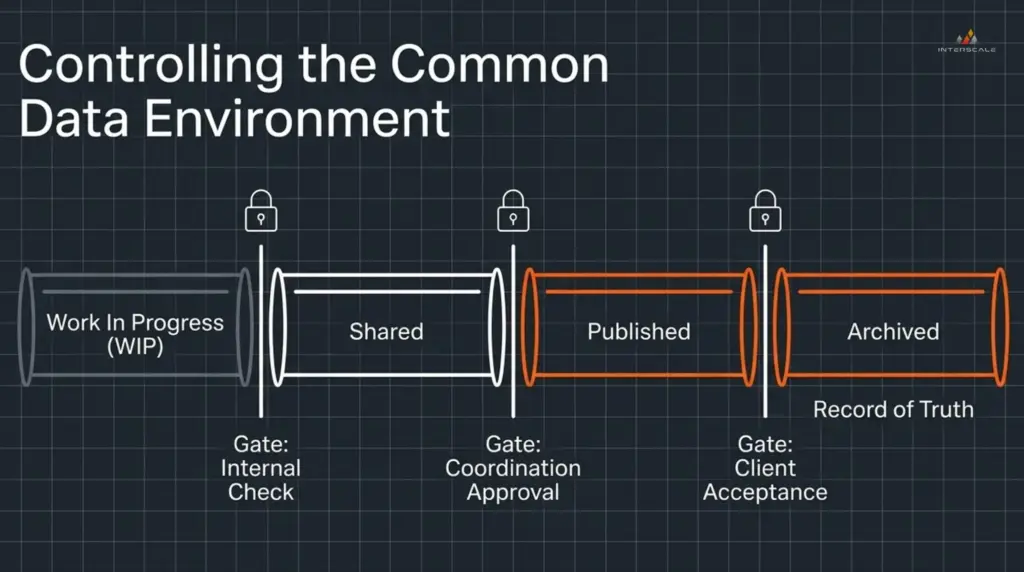
A usable CDE workflow shows how information moves from work in progress to shared, published, and archived states.
The plan should also define permissions, review steps, status codes, revision rules, and rejection paths.
This matters because the CDE becomes the project’s information control point. If the workflow is unclear, teams may upload the right file to the right platform while still leaving others unsure whether it can be used for coordination, pricing, construction planning, or handover.
Yes, this opener is too short because it explains frequency, but not the purpose of the cadence. The section should show that coordination rhythm is about decision timing, issue ownership, and closeout discipline.
Set the Coordination and Review Cadence
Set the coordination and review cadence so model exchanges, checks, issue reviews, and closeout actions happen at the right project rhythm.
The cadence should match the project stage and risk level. Weekly reviews may suit construction documentation or active contractor coordination. Fortnightly reviews may work during design development. Monthly reviews may be enough for early feasibility.
The plan should also define what happens before and after each review. That includes model submission deadlines, clash test timing, issue owners, response dates, and escalation rules for unresolved items.
Test the Plan Before Full Rollout
Test the BIM management plan with a small workflow sample before the whole project depends on it.
Ask each discipline to publish one model, follow the naming convention, use the CDE workflow, export the required format, respond to one issue, and confirm the approval path. This gives the team a practical check on whether the plan works in real delivery conditions.
The test can reveal unclear permissions, broken naming rules, inconsistent coordinates, missing templates, unrealistic deadlines, or approval steps that nobody owns. Fixing those issues early keeps the plan from becoming a document that looks complete but fails during model exchange.
Common BIM Management Plan Mistakes Australian Project Teams Make
The most common BIM management plan mistakes are unclear ownership, vague requirements, loose CDE rules, weak commercial scoping, informal BIM dependency, delayed coordinate decisions, and unrealistic standards.
The list below shows where a complete-looking plan can still fail in delivery:
- Using the plan as admin: A template helps structure the document, but the project still needs real decisions on scope, roles, software, and handover.
- Writing vague BIM requirements: “LOD 300” and “fully coordinated” need clear rules for model scope, tolerance, review, and closeout.
- Leaving the CDE loose: A CDE needs publishing rules, status codes, revision control, and clear permissions before teams can trust the information.
- Missing the commercial impact: Clash reporting, model federation, handover data, and frequent exchanges can change scope, cost, resourcing, and programme.
- Relying on one BIM hero: When one person owns naming, exports, checks, and issue tracking, the workflow becomes fragile.
- Delaying coordinate decisions: Late coordinate changes can break federation, drawings, set-out, clash tests, and subcontractor models.
- Writing standards nobody follows: A standard that is too hard to use becomes a workaround generator.
How to Build a BIM Management Plan That Holds Up During Real Project Delivery?
To build a BIM management plan that holds up during real project delivery, the friction points need to become usable project rules.
That’s why Interscale’s BIM management services help Australia AEC teams when model ownership is unclear, CDE publishing feels messy, or handover requirements are hard to translate into daily BIM work.
Our support fits your teams that can already model but need a cleaner way to manage BIM decisions.
The aim is to make your team know which model can be used, who owns the next action, and what needs to be checked before information moves forward.
That is why you can book a free discussion session with an Interscale BIM expert before the plan becomes a project problem.
You can use the session to review where your BIM management plan needs clearer rules in Australian project delivery.